
Introduction: Why Medical Device Development Demands a Different Approach
When hardware founders from consumer electronics or IoT backgrounds first approach medical device projects, they often underestimate the complexity. “It’s just a sensor with Bluetooth,” one startup founder told us after their first failed FDA submission. Six months and $200,000 later, they understood: medical devices aren’t consumer electronics with stricter aesthetics—they’re a fundamentally different discipline.
In 2026, the convergence of healthcare technology, wearable sensors, and AI-powered diagnostics has created unprecedented opportunities for hardware startups. The global medical device market continues to expand, driven by aging populations, telemedicine adoption, and the demand for continuous health monitoring. For founders willing to navigate the regulatory landscape, medical device design offers high barriers to entry—and therefore, less competition.
But those barriers exist for good reason. A malfunctioning fitness tracker might annoy users; a malfunctioning insulin pump can kill them. This guide walks you through everything you need to know about medical device design in China, from regulatory frameworks to development processes, helping you understand what’s different and how to succeed.
Why Medical Device Design Is Fundamentally Different
The Stakes Are Different
Consumer electronics optimize for cost, features, and time-to-market. Medical devices optimize for patient safety first, then efficacy, then usability—cost and features follow.
This reordering affects every decision:
| Aspect | Consumer Electronics | Medical Devices |
|---|---|---|
| Primary Goal | User acquisition, feature parity | Patient safety, clinical efficacy |
| Failure Mode | Returns, refunds, bad reviews | Injury, death, lawsuits, recalls |
| Development Timeline | 6-18 months | 18-36+ months |
| Documentation | Marketing materials, manuals | Design history files, risk analyses, validation reports |
| Post-Market | Optional software updates | Mandatory vigilance, adverse event reporting |
The Regulatory Burden
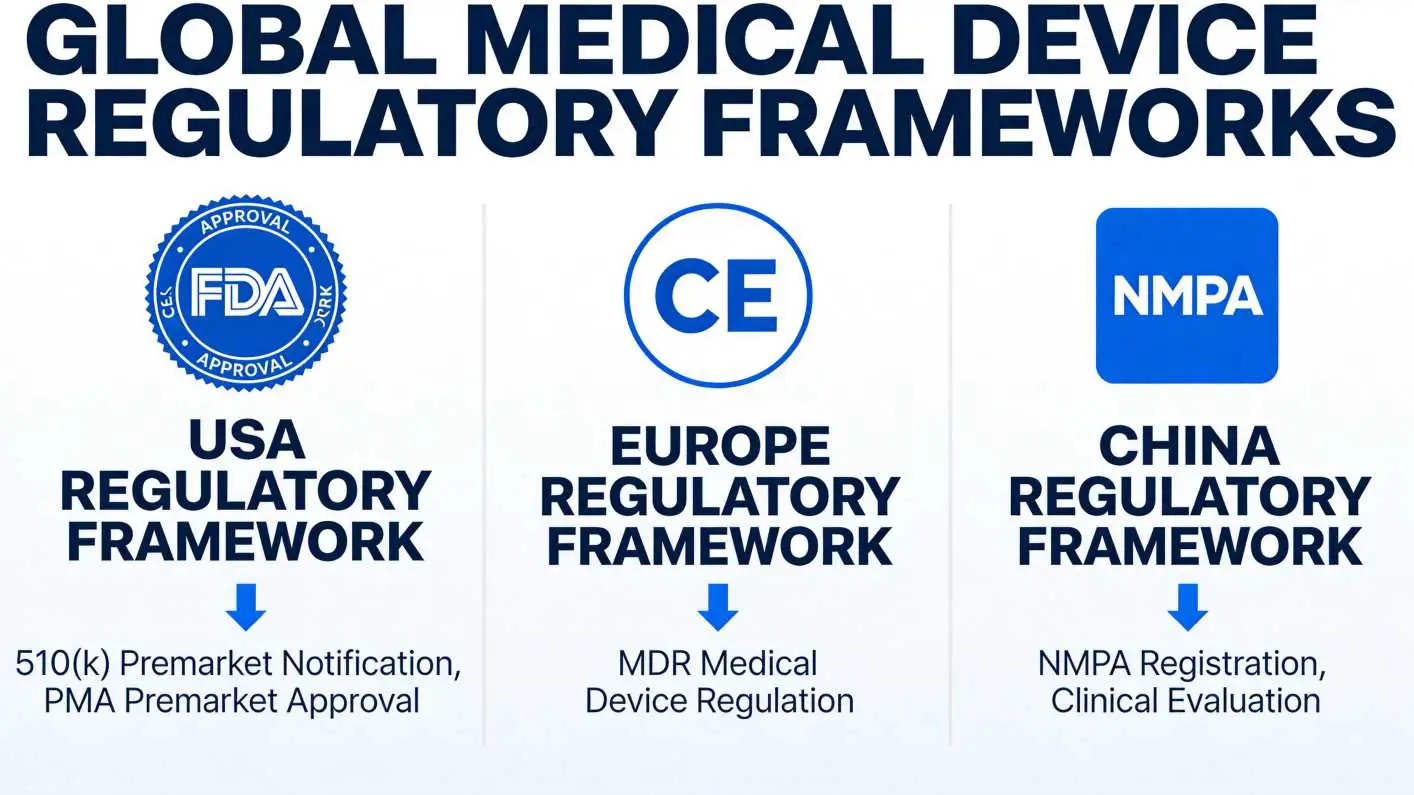
In the United States, medical devices are regulated by the FDA under the FD&C Act. In Europe, the CE Mark requires conformity with the Medical Device Regulation (MDR). In China, the National Medical Products Administration (NMPA) governs device approvals. Each framework has distinct requirements, but all share common principles:
- Risk-based classification — Devices are categorized by risk level (Class I, II, III), determining regulatory pathway
- Quality management systems — ISO 13485 certification is essentially universal
- Clinical evidence — Higher-risk devices require clinical trials or extensive equivalence documentation
- Post-market surveillance — Ongoing safety monitoring is mandatory
For hardware founders, this means documentation isn’t paperwork—it’s the product. Every design decision must be traceable, justified, and recorded.
Understanding Regulatory Frameworks
FDA (United States)
The FDA classifies devices into three classes based on risk:
- Class I (Low Risk): Bandages, handheld surgical instruments → General controls, mostly exempt from premarket review
- Class II (Moderate Risk): Blood pressure monitors, infusion pumps → Special controls + 510(k) premarket notification
- Class III (High Risk): Pacemakers, implantable defibrillators → Premarket approval (PMA) required
For most wearable health monitors and diagnostic devices, you’ll likely navigate the 510(k) pathway, demonstrating “substantial equivalence” to a legally marketed predicate device. This requires comparative testing, performance data, and comprehensive documentation—but is less burdensome than PMA.
Key 2026 update: The FDA’s Digital Health Center of Excellence has issued new guidance on AI/ML-enabled devices, requiring documented algorithm training, validation on independent datasets, and performance monitoring plans.
CE Mark (European Union)
Under MDR 2017/745, which fully took effect, the CE Mark process has become significantly more rigorous than its predecessor. Key changes:
- Enhanced clinical evaluation requirements for all device classes
- UDIs (Unique Device Identification) mandatory for traceability
- EUDAMED database for registration and adverse event reporting
- Notified Body capacity constraints have created bottlenecks—plan for 12-18 months for Class IIa/IIb approvals
NMPA (China)
China’s regulatory landscape has modernized rapidly. For overseas manufacturers:
- CFDA (now NMPA) approval is required for devices sold in China
- Imported devices face additional requirements for Chinese language documentation and local testing
- Unique considerations: China requires testing within Chinese accredited labs for certain device categories, which can add 3-6 months to timelines
Strategic note: Many hardware startups initially target US and EU markets, then pursue NMPA registration once they have established regulatory documentation and CE/FDA clearance. This staged approach reduces upfront investment while building documentation maturity.
Design Considerations for Medical Electronics
Biocompatibility
Any component that contacts patient tissue or skin must be biocompatible. This means:
- Material selection using ISO 10993 standards for biological evaluation
- Skin-safe plastics (medical-grade polycarbonate, ABS, TPU)
- Coatings and surface treatments that won’t cause irritation or allergic reactions
- Testing protocols using accredited laboratories for cytotoxicity, sensitization, and irritation testing
For wearables that contact skin for extended periods (continuous glucose monitors, heart rate patches), this becomes critical. Early material selection decisions can save thousands in reformulation later.
Electrical Safety
Medical electrical equipment must meet IEC 60601-1 standards, which cover:
- Insulation and protective grounding to prevent electrical shock
- Leakage current limits far stricter than consumer electronics
- Thermal management for components that could reach unsafe temperatures
- EMC (Electromagnetic Compatibility) ensuring the device doesn’t interfere with other equipment or succumb to electromagnetic interference
For home-use devices, IEC 60601-1-11 (collateral standard for home healthcare environments) adds requirements for usability in non-clinical settings.
Software as a Medical Device (SaMD)
If your device includes software—whether embedded firmware or mobile apps—you likely fall under IEC 62304 for software lifecycle processes. This standard requires:
- Software development planning with documented processes
- Risk analysis for software-related hazards
- Software architectural design and detailed design documentation
- Unit and integration testing with traceability to requirements
- Release and maintenance procedures for post-market updates
AI/ML-enabled devices face additional scrutiny, requiring documented training datasets, validation on independent test sets, and performance monitoring plans.
Finding the Right Development Partner in China
Why Location Matters
China, particularly the Shenzhen-Guangdong corridor, offers unmatched advantages for medical device development:
- Supply chain depth for sensors, components, and materials
- Manufacturing ecosystem for everything from PCB assembly to injection molding
- Cost efficiency without sacrificing quality when managed correctly
- Rapid iteration with prototype-to-production pathways in close proximity
But not all development partners are equal. The right partner understands both the technical requirements and the regulatory landscape.
What to Look For
| Criteria | Why It Matters |
|---|---|
| ISO 13485 Certification | Demonstrates quality management system compliance |
| Relevant Experience | Prior medical device projects with similar risk classifications |
| Regulatory Knowledge | Can navigate FDA, CE, or target market submissions |
| Documentation Capability | Produces design history files, risk analyses, validation reports |
| Supply Chain Relationships | Access to verified medical-grade component suppliers |
| IP Protection | Documented policies protecting client designs |
Red Flags to Avoid
- “We’ve worked with medical devices before” without specifics — Ask for case studies and device classifications
- “We’ll handle the regulatory stuff” without detail — Regulatory submission is your responsibility; partners should support, not lead
- No quality management documentation — Ask for ISO 13485 certificate and internal audit records
- Unwillingness to provide references — Past clients should be accessible
How OPD Design Supports Medical Device Projects
At OPD Design, we’ve guided hardware startups through FDA 510(k) submissions, CE Mark applications, and NMPA registrations. Our medical device development process includes:
- Cross-functional teams with expertise in industrial design, electronics, firmware, and regulatory affairs
- Documentation-first approach building design history files alongside technical development
- Risk-based design practices applying ISO 14971 risk management principles from concept through production
- Validated supplier network for medical-grade components and materials
- Regulatory support working alongside your regulatory consultants or as an extension of your team
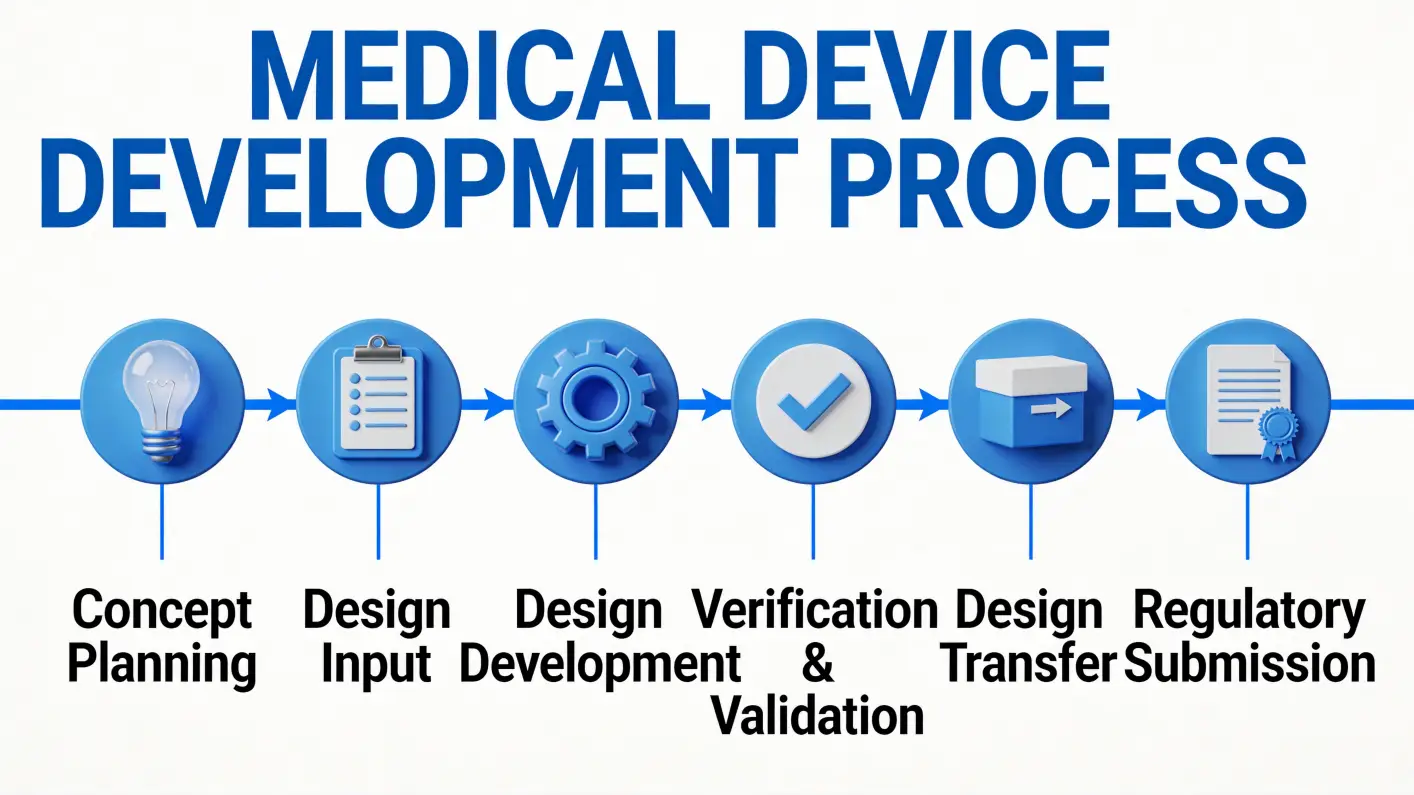
The Medical Device Development Process
Phase 1: Concept & Planning
Duration: 4-8 weeks
Before design begins, establish the foundation:
- Define intended use and user population — What does the device do, and for whom?
- Preliminary risk classification — Which regulatory pathway applies?
- Competitive analysis — What’s already cleared, and how will you demonstrate equivalence or differentiation?
- Development planning — Timeline, budget, resource allocation
- Quality management setup — Establish design controls and documentation procedures
Key output: Design and development planning document (DHF foundation)
Phase 2: Design Input
Duration: 6-12 weeks
Translate user needs and regulatory requirements into measurable design specifications:
- User requirements — What users need (not how to achieve it)
- System requirements — Functional, performance, interface specifications
- Risk management file — ISO 14971 risk analysis identifying hazards and mitigations
- Design inputs reviewed and approved per quality system
This phase often gets rushed. Don’t. Design inputs that change late in development cause the most expensive rework.
Phase 3: Design Development
Duration: 12-24 weeks
Technical implementation across disciplines:
- Industrial design — Form, ergonomics, user interface for patient safety
- Mechanical design — Enclosures, assemblies, materials per ISO 10993
- Electronics design — Schematics, PCB layout, compliance with IEC 60601-1
- Firmware/software — IEC 62304-compliant development lifecycle
- Design reviews — Formal checkpoints with cross-functional stakeholders
Phase 4: Design Verification & Validation
Duration: 8-16 weeks
Testing confirms the design meets specifications and works for intended use:
| Verification vs. Validation | Verification | Validation |
|---|---|---|
| Question | “Did we design it right?” | “Did we design the right thing?” |
| Method | Testing against design inputs | Testing against user needs |
| Perspective | Engineering | Clinical/real-world use |
- Design verification — Testing units against design specifications
- Biocompatibility testing — ISO 10993 testing per material-contact duration
- Electrical safety testing — IEC 60601-1 compliance testing
- EMC testing — IEC 60601-1-2 electromagnetic compatibility
- Usability testing — IEC 62366-1 formative and summative evaluation
- Clinical evaluation — Literature review or clinical investigation per MDR/FDA guidance
Phase 5: Design Transfer
Duration: 8-16 weeks
Preparing for production:
- Process validation — IQ, OQ, PQ for critical manufacturing processes
- Supplier qualification — Audits and qualification of component vendors
- Production documentation — Work instructions, inspection procedures
- First article inspection — Production-intent samples meeting specifications
Phase 6: Regulatory Submission & Launch
Duration: 6-18 months (parallel to development)
- Compile technical documentation (design history file, risk management file, test reports)
- Submit to regulatory authority (FDA 510(k)/PMA, EU Notified Body, NMPA)
- Respond to authority questions and requests for additional information
- Obtain clearance/approval
- Post-market surveillance planning
Common Challenges and How to Avoid Them
Challenge 1: Underestimating Documentation Burden
Problem: Teams treat documentation as administrative overhead rather than core product development work.
Impact: Failed audits, submission rejections, design changes without traceability.
Solution: Build documentation workflows alongside technical development. Use electronic quality management systems (eQMS). Designate documentation owners.
Challenge 2: Changing Requirements Mid-Development
Problem: User needs evolve, regulatory guidance changes, or competitive landscape shifts.
Impact: Expensive rework, timeline slippage, documentation inconsistency.
Solution: Lock design inputs before detailed development begins. Use formal change control per quality system. Assess impact before implementing changes.
Challenge 3: Insufficient Usability Engineering
Problem: Devices work in controlled environments but fail in real home-use conditions.
Impact: Use errors, adverse events, FDA warning letters.
Solution: Apply IEC 62366-1 usability engineering process from early concept. Test with representative users in representative environments. Document use errors and mitigations.
Challenge 4: Supplier Quality Issues
Problem: Component substitutions, process variations, or quality drift.
Impact: Device failures, recalls, patient harm.
Solution: Qualify suppliers rigorously. Maintain incoming inspection. Document supplier changes. Establish long-term partnerships over transactional relationships.
Challenge 5: Regulatory Pathway Mismatches
Problem: Misclassifying device risk, using wrong predicate device, insufficient clinical data.
Impact: Submission rejections, significant timeline delays, need for clinical trials.
Solution: Engage regulatory consultants early. Pre-submission meetings with FDA (Q-sub) can clarify pathway. Build regulatory strategy into development planning.
FAQ: Medical Device Design in China
How long does it take to develop a medical device in China?
For moderate-complexity devices (Class II), expect 18-24 months from concept to market clearance, assuming regulatory strategy is established early. Complex devices (Class III) or those requiring clinical trials may take 3-5 years.
What’s the cost difference between medical device and consumer electronics development?
Medical device development typically costs 2-5x more than equivalent consumer products due to regulatory requirements, extended testing, documentation overhead, and quality system compliance. For context, a $50,000 consumer electronics prototype might cost $150,000-$250,000 as a medical device.
Do I need FDA clearance before manufacturing in China?
No—but you need a quality system (QSR/21 CFR 820, now transitioning to QS Regulation) before you manufacture. FDA does not approve manufacturing locations but may inspect them. Many startups establish manufacturing after FDA clearance, while using prototyping partners in China during development.
Can I use consumer-grade components in medical devices?
Sometimes, but with caution. Consumer-grade components lack the documentation, consistency, and quality assurance of medical/industrial grade parts. If used, you’ll need additional validation to demonstrate fitness for intended use. For critical safety components (power management, sensing, communication), medical-grade is usually required.
What’s the advantage of developing in China vs. domestically?
China offers faster iteration cycles, deeper component supply chains, lower prototype costs, and established manufacturing ecosystems. The trade-off is navigating international regulatory requirements and potentially longer component lead times for imported materials. Many successful medical device startups use hybrid approaches—design and regulatory in the US/EU, prototyping and manufacturing in China.
How do I protect my intellectual property when developing in China?
Implement non-disclosure agreements with all partners. File patents in China before disclosing inventions. Work with partners with documented IP protection policies. Consider trade secret protections for processes. Note that enforcement has improved significantly, but prevention remains essential.
Conclusion: Turning Regulatory Complexity into Competitive Advantage
Medical device development in China presents genuine challenges—but for hardware founders willing to navigate the regulatory landscape, the rewards are substantial. Less competition, lower development costs, and manufacturing depth create conditions where well-prepared startups can build significant advantages.
The key is understanding that medical device design isn’t just about engineering—it’s about engineering within a quality system, documented for regulatory scrutiny, and validated for patient safety. Those who master this discipline gain durable competitive moats that consumer electronics competitors cannot easily replicate.
Whether you’re developing a continuous glucose monitor, a home sleep apnea diagnostic, or an AI-powered stethoscope, the principles remain consistent: start with regulatory strategy, build quality into the process, document thoroughly, and validate rigorously.
If you’re exploring medical device development and want to understand how a China-based development partner can support your journey from concept to regulatory clearance, we’re here to help. Contact OPD Design to discuss your project.