

Choosing a rapid prototyping service sounds easy. You send a CAD file. You get a part back. But this choice matters more than it looks.
Here’s why. A prototype can look fine on the outside and still hide real flaws. The walls might be too thin. The draft angle might be missing. The tolerance might not fit the part’s job. These flaws often stay hidden at first. Then they show up later as a failed mold trial. By that point, the fix costs much more time and money.
So this guide skips the usual sales talk. Instead, it covers what makes a product prototyping service worth hiring. The best partners catch problems early, well before parts reach the mold shop.
Define Your Goals Before Choosing a Rapid Prototyping Service
Before you compare vendors, get clear on one thing first. What does this prototype need to prove? “I need a prototype” is not a real goal. It’s just a stand-in for a more specific need.
Ask yourself a few questions:
- Do you want to check looks and size, or test if a snap-fit holds?
- Do you need to run a hinge through many cycles, or just check how a button feels?
- Is this for an investor demo, or for an engineer who checks exact tolerances?
- Are you testing a simple, low-cost build before you commit to full development?
Naming the prototype type also helps. A concept model, cosmetic model, feasibility build, and mock-up each answer a different question. So does a smart, low-cost build made to test just the core idea. Picking the wrong type wastes a whole round.
Here’s an example. A concept model for a design review can often use a loose tolerance and a rough finish. But a working prototype for a bearing part usually can’t. It needs tighter, machine-checked tolerances instead. One common mistake is mixing these two up. Teams over-build a simple concept model. Or they under-build a part that truly needs to work.
Match the Technology to the Tolerance and the Volume
No single process works for every prototype. The right method depends on the part’s shape, its material, its tolerance, and how many units you need.
| Technology | Tolerance (General Range) | Good For | Watch Out For |
| FDM 3D printing | Loosest of the group | Early form checks, fixtures, cheap test runs | Visible layer lines, weaker strength in one direction |
| SLA/resin printing | Tighter than FDM | Cosmetic models, fine detail, snap-fit tests | Can turn brittle over time or in sunlight |
| CNC machining | Tightest of the group | Working parts, metal prototypes, press fits | Cost rises fast with complex inner shapes |
| Vacuum casting | Close to SLA | Small batches in rubber-like or plastic-like resins | Mold quality drops as you make more parts |
*Real tolerances shift based on the machine, the material, and the part’s shape. Treat this table as a general guide, not a fixed spec. Always ask your provider to quote a tolerance for your exact part.
CNC machining is often the right choice when a part must fit tightly with another part. Think of a bearing seat or a sealing groove. 3D printing, on the other hand, wins on speed and low cost. It’s great for anything you’ll redesign in just a few days. Vacuum casting sits in between the two. It works well when you need a small batch that feels like an injection-molded part. And you’re not ready to pay for steel tooling yet.
It also helps to know that “3D printing” isn’t just one process. A joint ISO and ASTM standard defines seven categories, each with its own accuracy and its own material behavior (ISO/ASTM 52900:2021). That’s why “can you 3D print this?” isn’t really a full question on its own.
If your product will move to volume production later, ask your prototyping partner how they plan that shift. OPD Design’s product prototyping services use CNC machining, 3D printing, and vacuum casting side by side. The team picks whichever method fits what each design round needs to prove.
The Design Details That Decide Whether a Prototype Works
Many prototyping problems don’t start on the shop floor. They start in the CAD file. A few checks matter more than most teams expect:
- Wall thickness. Plastic parts headed for volume production need walls that aren’t too thin or too thick for the material. Too thin, and the part may warp. Too thick, and you’ll likely see sink marks and longer cooling times. Your provider can confirm the right range for your resin and part.
- Draft angles. Even a prototype tool needs some draft on its side walls. The right angle depends on the texture, the material, and how deep the part is. Without enough draft, parts stick, surfaces get scuffed, and ejector pins leave marks.
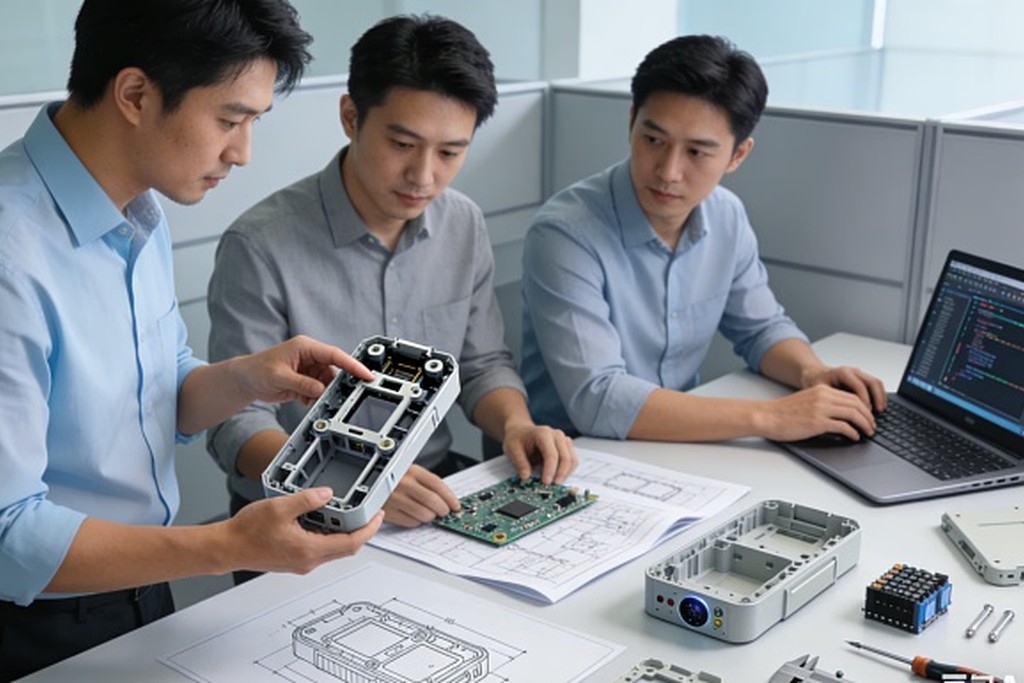
- Electronics and PCB fit. If the product holds a circuit board, leave room in the CAD file for board mounting, connector access, and wire routing before the first build. Skipping this step is a common reason electronic prototypes need a second full round.
- Fewer, smarter parts. Every extra part in an assembly adds a fastener, a tolerance to track, and one more build step. So the prototype stage is the cheapest time to ask: could two brackets become one part instead?
- Strength and heat. If the product holds electronics, check if the housing needs ribs for strength or vents for airflow. A prototype that looks great but runs hot in real use hasn’t proven much at all.
A good partner flags these issues during the CAD review, not after the parts break. That’s the real gap between a shop that just prints parts and one that does real product engineering. OPD Design builds these checks into its mechanical design process. A prototype’s mechanical health often decides whether the next round goes faster or slower.
Testing Should Teach You Something, Not Just Make a Part
A prototype that’s never tested against a real need is just an expensive paperweight. So ask any provider how they test a part beyond a quick look.
In practice, good testing might include a drop test for a handheld device, or cycle testing for a hinge or latch. It might mean a size check against the CAD model, or a fit test with parts from another supplier. For parts with strength or heat needs, running a simulation before the first build often saves time later. It can catch problems before they get baked into metal or plastic.
This point matters more than it sounds. NIST’s research on tolerance rules notes that size and shape must be set and checked early. If not, small errors add up as a design moves toward production (NIST, Tolerance Specification for Additively Manufactured Products). In short, “it looks right” isn’t a real test. Measuring it against a tolerance is the real test. This is where good product prototype development earns its keep. The value isn’t in the part itself. It’s in what the part teaches you before the next round.
Manufacturing Readiness: The Part Many Prototyping Shops Skip

A prototype that can’t guide tooling choices is only doing half its job. So ask directly: does this provider think about manufacturing while the prototype is still being built? Or only after you ask for a mold quote?
A solid design-for-manufacturing (DFM) review at the prototype stage often catches useful issues. This might include gaps that would need extra tooling, wall thickness that swings too much and could warp later, or shapes that would cost more than expected to produce at volume. ASME’s guidance on design for manufacturing puts it simply: the goal is the lowest cost without losing function. That balance needs to be built in early, not fixed later (ASME, Design for Manufacturing Principles).
If tooling is part of your plan, ask how the provider handles that handoff, since decisions made now shape part cost and quality later. OPD Design covers one version of this handoff in its guide to injection mold development, and ties prototyping into its broader product design work.
Supply Chain, Speed, and Communication Matter Too
Technical skill isn’t the whole story. A few practical questions are worth asking before you commit to a provider:
- How many design rounds does your quote assume? What happens if testing finds a flaw in the first one?
- What’s your typical lead time by process? How does that change with part complexity or order size?
- Do you source materials locally? How does that affect lead time if a resin or metal runs short?
- Who keeps the CAD files and tooling data if we ever switch suppliers?
These questions matter because prototyping rarely happens just once. As a product moves from concept to testing to production, needs keep shifting. As a result, a partner who writes down decisions clearly tends to make each round faster than the last.
What to Look for in a Product Prototyping Company
| Area | What to Check |
| Technology fit | Can they explain why a method suits your part, not just offer whatever they own? |
| Tolerance discipline | Do they quote tolerances for your exact part, not a generic number? |
| Testing | Is testing built into the process, or something you have to ask for? |
| DFM awareness | Do they flag mold-readiness issues while prototyping, not after? |
| Speed of fixes | Can they turn around a design fix quickly and at a fair cost? |
| Communication | Do they explain changes and trade-offs in plain terms? |
Whether you call it a prototype development company or a product prototyping partner, the name matters less than this: can they answer these questions clearly for your product?
How OPD Design Approaches Prototype Development
OPD Design treats prototyping as one stage in a longer product journey. It’s not a standalone task. Its process runs through six steps: 3D concept design, simulation checks, step-by-step prototyping, fast builds for urgent tests, high-fidelity models, and a final review that checks the design against real manufacturing needs. The team uses CNC machining, 3D printing, or vacuum casting, based on what each stage needs to prove.
The same team also handles mechanical design and mold development. This helps most with products that mix mechanical parts and electronics, where one prototype has to prove fit, heat behavior, and assembly all at once. This keeps prototype feedback connected to later manufacturing decisions and reduces the risk of redesigning the same part twice.
Conclusion
In the end, a good rapid prototyping partner does more than turn a file into a part. They ask what the prototype needs to prove. They suggest a technology that fits your tolerance and volume. They catch design problems before tooling starts. And they carry what they learn into the next stage of the build. Price and speed still matter, of course. But they matter less than whether the whole process lowers your risk as the product moves toward production.
If you’re ready to discuss your prototype requirements, contact us to explore the right prototyping approach for your product.
FAQs
1. What tolerance can I expect from a rapid prototype?
It depends on the process, the material, and the part’s shape. As a general pattern, CNC machining holds the tightest tolerances. SLA printing sits in the middle. Standard FDM printing is the loosest of the common methods. Ask your provider to quote an exact tolerance for your part, rather than trust general numbers.
2. What types of prototypes can I ask a provider to build?
Most shops can build several types, each suited to a different stage. Common ones include concept models, cosmetic models, feasibility builds, mock-ups, and functional or electronic prototypes for products with a circuit board. Naming the type up front helps the provider quote the right process and tolerance.
3. Is vacuum casting a substitute for injection molding?
Not quite. Vacuum casting uses a silicone mold that wears down after a limited number of parts. The exact number depends on the material and the part’s shape. This makes it useful for small, production-like batches. But it isn’t tough enough for full production runs.
4. When should a manufacturing readiness review happen?
As early as possible. Catching a draft-angle or wall-thickness issue during prototyping usually costs far less than finding it after the steel tooling is cut.
5. Can one prototype work for both investor demos and functional testing?
Sometimes, but it helps to set your priorities first. A high-fidelity prototype built for looks may not survive the same drop or cycle test that a working prototype is built for.
6. What’s the biggest mistake teams make when choosing a prototyping provider?
Choosing based on price or speed alone. Teams should also check if the provider can catch design or manufacturing issues before the parts get built.