
Manufacturing delays usually come from decisions made too late. The most common causes are design changes after release, designs that are hard to produce, tooling problems, part shortages, unclear documents, late compliance checks, late artwork, and quality issues found at the end. Product manufacturing services help most when they join the project early and plan these areas together.
Product manufacturing services connect a finished design to a working production line. When this link is weak, schedules slip. A delay of a few weeks can affect a launch, a budget, and a customer relationship.
In this guide, we explain what causes manufacturing delays and what you can do about each one. It is written for startups, inventors, and product teams that plan to produce a physical or connected product. We share what we see in our own projects at OPD Design, and we keep the advice practical.

What Product Manufacturing Services Cover
Product manufacturing services help turn a validated design into a repeatable product. The scope varies by project, but it often includes supplier coordination, assembly planning, pilot runs, quality checks, and support during the first production batches.
At OPD Design, we see manufacturing as part of the whole development path, not a separate step at the end. Our product manufacturing services focus on validating production processes and quality consistency. That work depends on decisions made earlier in design and engineering.
This point matters for delays. Most delays do not start in the factory. They start earlier, and the factory is where they become visible.
Cause 1: Design Changes After Release
A design change after release is one of the most common causes of delay. A new idea arrives, a customer asks for a feature, or a test shows a problem. Each change can affect tooling, parts, test steps, and packaging.
Why it happens
Teams often release a design before every question is settled. They plan to fix details later. Later arrives when tooling is already in progress.
How to avoid it
Set a clear design freeze date. After that date, review every change for its effect on cost and schedule. Use a short approval step so only changes with a strong reason go through.
Early design choices matter here. Good industrial product design services consider form, use, and production at the same time. When the shape, materials, and finish suit the manufacturing process from the start, fewer changes are needed later.
Cause 2: A Design That Is Not Ready for Production
A design can look good and work well as a prototype but still be hard to build in volume. Parts may be hard to assemble. Tolerances may be too tight. A snap fit that works on one sample may fail on a thousand.
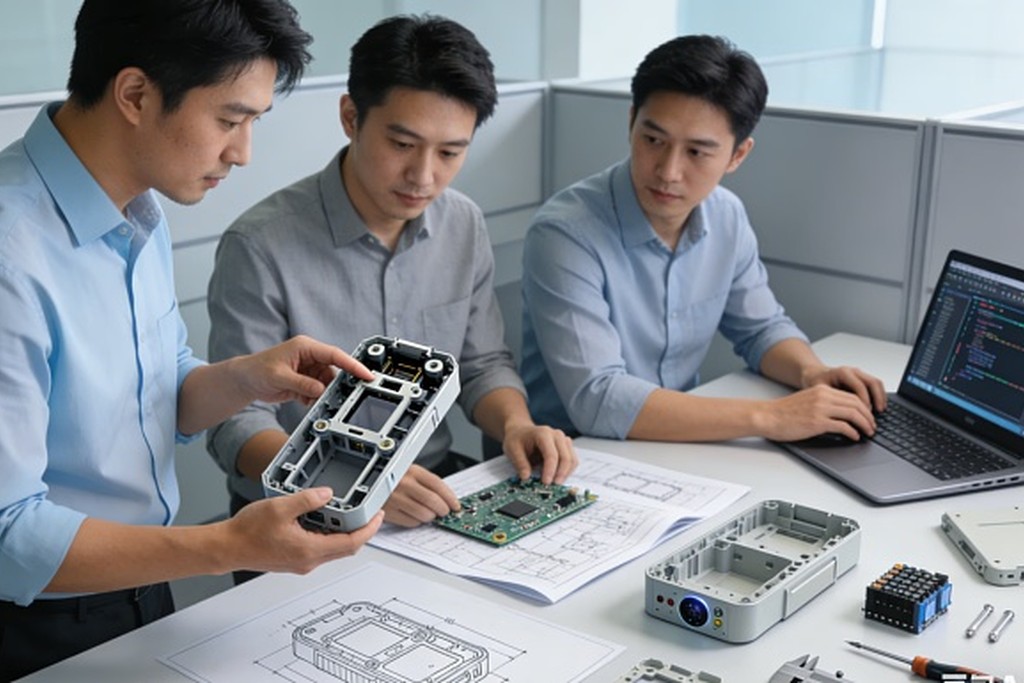
A mechanical design company turns the product’s structure and appearance into engineering that can be built. Production-ready mechanical design checks wall thickness, draft angles, assembly order, and access for service. It also checks how parts fit together across normal variation.
Ask your team these questions before release:
- Can each part be made with a standard process?
- Does the assembly order make sense for a worker or a machine?
- Are tolerances realistic for the chosen process?
- Can the product be opened for service or repair if needed?
Asking a manufacturing partner to review the design at this stage often finds problems that are easy to fix on paper.

Cause 3: Tooling and Mold Problems
Molds are costly and slow to change. If a first mold trial shows problems with fit, finish, or strength, the team must adjust the tool and test again. Each round adds time.
Common tooling issues include warped parts, visible flow lines, poor sealing surfaces, and parts that do not fit together as drawn. Many of these can be reduced with early checks on wall thickness, draft angle, parting lines, and gate position.
Our intelligent cleaning robot case shows how this works in practice. The tooling team managed mold design and validation for the enclosure and internal parts. They paid close attention to the sealing surfaces for the dustbin and water tank, and they ran first and second mold trials to confirm part quality before moving on.
Plan time for more than one trial. A schedule with no room for a second round is a schedule at risk.
Cause 4: Parts Shortages and Long Lead Times
A product is only as ready as its slowest part. Some electronic components have long lead times. Some parts have only one source. Others reach the end of their life without warning.
Check supply early
For every key part, ask three questions. Is it in active production? Can you buy it from more than one source? What is the lead time at the quantity you plan to order?
Keep a living parts list
Maintain a bill of materials from the first prototype. Mark parts with long lead times or single sources. Identify an approved alternate for each risky part. Order long lead items early, even before the rest of the design is final, if the risk is high.
Keep some safety stock for parts that are hard to replace. A small buffer can protect a production slot. Product manufacturing services can help here by checking supply and lead time for key parts before the design is final.
Cause 5: Incomplete Documents and Unclear Specifications
A factory can only build what it can read. Missing drawings, outdated files, or vague notes lead to questions, and each question takes time to answer. Worse, the factory may guess, and a wrong guess can produce a batch that has to be redone.
A complete document set usually includes:
- Final 3D models and drawings with tolerances
- A bill of materials with approved suppliers
- Electronics files and firmware versions
- Assembly instructions and test procedures
- Finish, color, and material specifications
Keep one current version of each file. Track every change in a log. In our commercial smart coffee machine case, the team prepared standardized assembly documentation, coordinated the component supply chain, and set quality control procedures before the move to mass production. These documents gave everyone the same reference.
Exploring how to keep your production schedule on track? Our team works with startups and brands on design, engineering, prototyping, and production planning for physical products. Talk to us about your project and the risks you want to check early.
Cause 6: Late Compliance and Testing
Many products need approval before they can be sold. The rules depend on the product and the market. If testing starts late, a failed test can force a design change when tooling is done.
In the United States, radio frequency devices must meet technical requirements of the Federal Communications Commission before they are marketed or imported. The FCC explains the steps in its equipment authorization guide. Other regions have their own rules. Examples include CE marking in Europe and limits on certain materials under RoHS.
To avoid this delay, list the rules for each target market at the start. Plan test dates around the design freeze. Use units that match the final design for official testing, since later changes may make the results invalid. Book test lab time early, because labs can have waiting lists.

Cause 7: Late Brand and Packaging Artwork
Teams often finish the product and then turn to the box, the manual, and the labels. Printing and box production have their own lead times. If the artwork is not ready, finished products can wait in a warehouse.
A brand design company helps establish a consistent visual identity, including logo files, color standards, and packaging artwork. When these assets are ready early, the printer can start on time, and the packaging matches the product.
Plan these items in parallel with production:
- Final logo and color files in the formats the printer needs
- Box dimensions based on the final packed product
- Printed marks and regulatory symbols
- Manuals, quick start guides, and inserts
Check a printed sample of the box before the full run. A small error in color or size is easier to fix on one box than on thousands.
Cause 8: Quality Problems Found Late
If quality checks happen only at the end, problems appear when the whole batch is built. Rework and sorting then consume the schedule.
Move checks earlier. Inspect incoming parts. Check key steps along the line. Test the function of each unit. Record results so each batch can be traced back to its parts and process.
A pilot build helps a lot. It is a small production run with real parts, tools, and workers. In our sci-fi style electric ceramic stove case, the team coordinated component sourcing and supplier selection, then ran pilot runs and followed assembly quality and consistency of the sensor and light strip before volume shipment.
The international standard ISO 9001 sets out requirements for a quality management system. You do not need to certify your own company to learn from it. Its ideas about clear processes, records, and steady improvement apply to any production plan. Product manufacturing services that include pilot builds give you a low-cost way to test the process before volume.
Cause 9: Weak Communication With the Factory
Time zones, language differences, and unclear roles can slow a project. A question that waits two days for an answer can stop a line.
Good communication is simple. Name one contact on each side. Agree on how often you will meet. Use shared files with a clear naming system. Send photos and short videos when a problem is hard to describe in words.
Write down decisions after each call and send them to everyone. A short written summary prevents the same discussion from happening twice.
Delay Reference Table
The table below summarizes the causes of delay, what they can lead to, and a simple check to run early.
| Cause | What it can lead to | Early check |
|---|---|---|
| Design changes after release | Tooling rework and schedule slips | Set a design freeze and a change approval step |
| Design not ready for production | Hard assembly and part failures | Review the design with a manufacturing partner |
| Tooling and mold problems | Repeated trials and rework | Plan for more than one mold trial |
| Parts shortages | Waiting for components | Check supply and lead time for key parts |
| Unclear documents | Questions and wrong builds | Keep one current document set |
| Late compliance | Redesign before launch | List rules for each market and book labs early |
| Late artwork | Finished goods waiting for boxes | Prepare packaging artwork in parallel |
| Late quality checks | Rework on full batches | Run a pilot build and add in-line checks |
| Weak communication | Slow answers and repeated work | Name contacts and send written summaries |
How to Avoid Manufacturing Delays
You do not need a perfect process. A few habits make a large difference.
- Plan for production from the first design review.
- Set a design freeze date and respect it.
- Review the design with a manufacturing partner before tooling.
- Check supply and lead time for every key part.
- Keep documents complete, current, and versioned.
- List compliance rules for each target market early.
- Prepare packaging artwork in parallel with production.
- Run a pilot build and set quality checks before full volume.
- Keep communication clear and written.
Review this list at each project stage. Add notes on what you learn. The list becomes a record your team can use on the next product.
Conclusion
Manufacturing delays rarely come from one big failure. They come from small gaps that add up: a late change, an unclear drawing, a missing part, a test that started too late. Each gap is easier to close early than late.
Product manufacturing services work best when they join the project before tooling starts and look at design, parts, documents, compliance, and quality together. If you want to talk through your product and your production plan with a team that works across design, engineering, and manufacturing support, contact us today.
Frequently Asked Questions
What are product manufacturing services?
Product manufacturing services help move a finished design into production. They often include supplier coordination, assembly planning, pilot runs, quality checks, and support during early production batches.
What is the most common cause of manufacturing delays?
Late design changes are one of the most common causes. A change after release can affect tooling, parts, testing, and packaging, so each one needs a careful review.
How can I reduce the risk of part shortages?
Check every key part for active production, multiple sources, and lead time. Keep an approved alternate for risky parts, and order long lead items early.
Why is a pilot build useful?
A pilot build is a small production run with real parts, tools, and workers. It shows whether the product can be assembled and tested in a repeatable way before full production begins.
When should I start planning for compliance?
Start during the design stage. Compliance rules can affect circuit layout, materials, and labeling. Testing should use units that match the final design.