
Injection molding design guidelines are the set of engineering principles that determine whether your plastic part can be manufactured reliably, at scale, and within budget. Get them right, and your product flows from mold to mass production with minimal waste. Get them wrong, and you’re paying for mold modifications that cost thousands of dollars and weeks of delay — each time.
For hardware founders developing consumer electronics, IoT devices, smart home products, or any enclosure-based device, understanding these injection molding design guidelines before sending your files to a factory is not optional — it’s the single highest-leverage thing you can do to protect your timeline and budget.
When your product development partner runs DFM analysis on your plastic components, these guidelines form the foundation of every recommendation. This article distills the eight most critical rules into an actionable reference you can apply today.
Why Injection Molding Design Guidelines Matter More Than You Think
Injection molding produces roughly 30% of all plastic consumer products worldwide. From the enclosure of your smart thermostat to the housing of a medical wearable, the process is the backbone of hardware manufacturing at scale.
But the process has strict design constraints. Unlike 3D printing — where you can print nearly any geometry and worry about manufacturability later — injection molding demands that your design conform to the physics of molten plastic flowing into a steel mold under pressure.
Consider the cost of ignoring these constraints:
- A single mold modification to add draft angles: $2,000–$10,000
- Fixing sink marks by re-cutting a mold cavity: $5,000–$15,000
- Redesigning a part because wall thickness caused warpage: $3,000–$8,000 plus 4–6 weeks
By contrast, applying proper injection molding design guidelines during the CAD phase costs nothing. The better your design inputs, the smoother your collaboration with mold development engineers — and the fewer surprises you’ll encounter when steel meets plastic.
The 8 Essential Injection Molding Design Guidelines
Rule 1: Maintain Uniform Wall Thickness
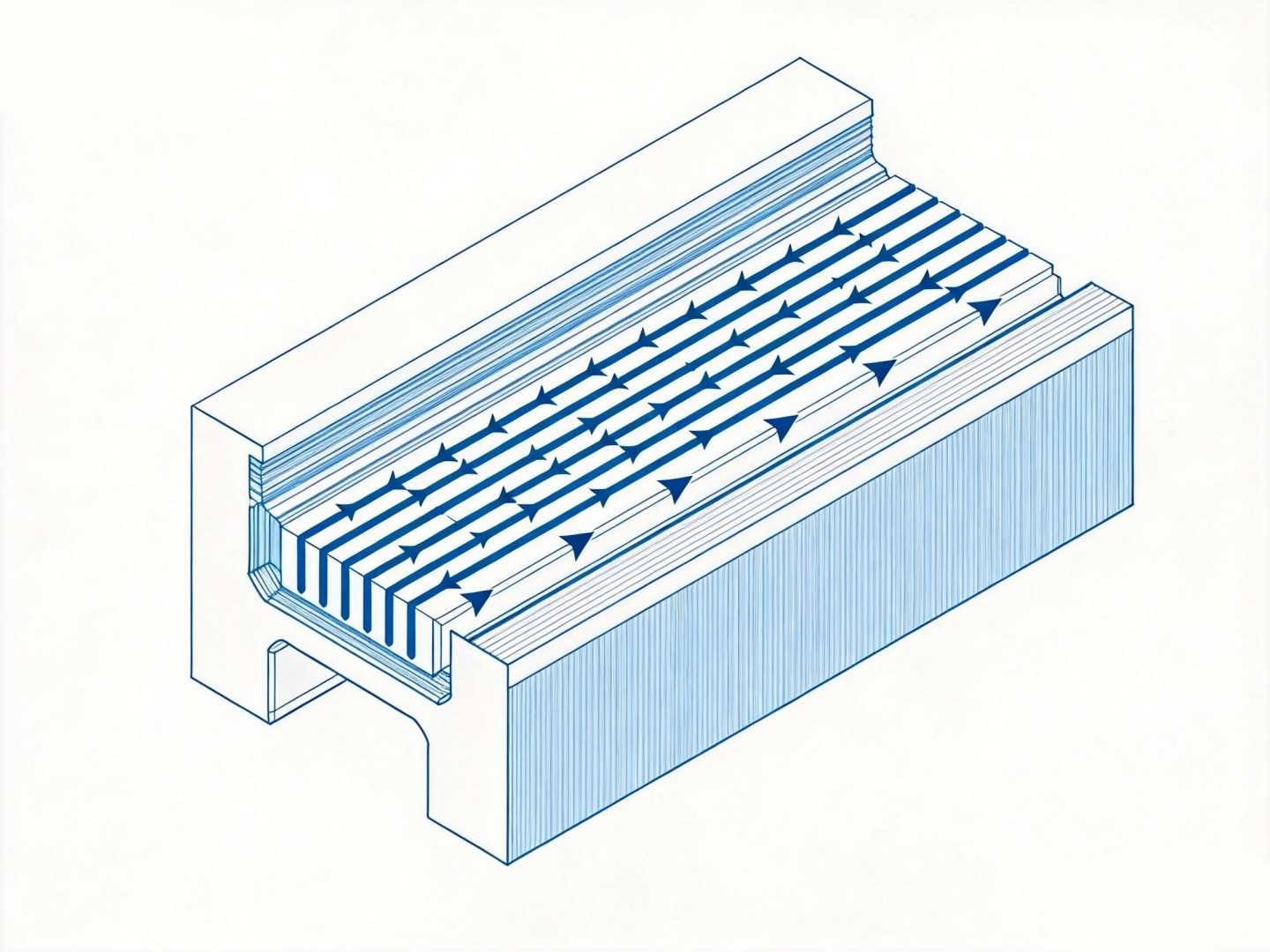
Wall thickness is the single most important design parameter in injection molding. It determines how plastic flows through the mold cavity, how quickly the part cools, and whether the final dimensions hold to specification.
The golden rule: keep nominal wall thickness consistent across the entire part.
When wall thickness varies — say 2 mm in one section and 4 mm in another — the thick section cools 40–50% slower. The thin walls solidify first while the thick section is still shrinking. This differential cooling creates internal stress, leading to warpage, sink marks, and cracking.
Key parameters:
- Recommended range for most thermoplastics: 1.5–3.0 mm
- Maximum variation: ±25% of nominal wall thickness
- Transition ratio: When thickness must change, use a 3:1 taper ratio (a 1 mm thickness change needs 3 mm of gradual transition)
Material-specific wall thickness ranges:
| Material | Recommended Wall (mm) | Key Properties |
|---|---|---|
| ABS | 1.2–3.5 | Impact-resistant, good surface finish |
| Polycarbonate (PC) | 1.0–4.0 | High impact, transparent, heat-resistant |
| Polypropylene (PP) | 0.8–3.8 | Chemical-resistant, flexible, lightweight |
| Nylon (PA6/PA66) | 0.8–3.0 | High strength, wear-resistant, hygroscopic |
| PC/ABS Blend | 1.2–3.5 | Balanced impact and processability |
| POM (Acetal) | 0.8–3.0 | Low friction, dimensionally stable |
Engineering tip: Every 1 mm reduction in wall thickness typically cuts cycle time by 15–25%. Thinner walls cool faster, meaning more parts per hour and lower per-unit cost. Don’t default to thicker walls “for strength” — use ribs instead (Rule 3).
Rule 2: Add Proper Draft Angles on Every Vertical Surface
Draft angles are the slight tapers added to vertical walls so the part can be ejected from the mold without scraping, sticking, or damaging the surface finish.
It sounds trivial. But missing or insufficient draft is one of the most common reasons molders reject a design — and one of the most expensive to fix after tooling is cut.
“After 20 years of building molds, the same draft angle mistakes come up over and over. The ones that cost the most money are the ones on internal features like ribs, bosses, and gussets — because ejector pins can’t reach them directly.” — Zetar Mold Engineering Guide
For comprehensive material property data sheets, reference MatWeb’s polymer database, which provides shrinkage rates, melt flow indices, and heat deflection temperatures for thousands of grades. Protolabs’ injection molding design guide also offers an excellent free DFM checklist tool for validating your design before submitting to any manufacturer.
Draft angle requirements by feature:
| Feature | Minimum Draft | Preferred Draft |
|---|---|---|
| Smooth exterior walls | 0.5° | 1.5–2° |
| Interior ribs and bosses | 0.5° per side | 1–2° per side |
| Textured surfaces (light) | 1.0° | 1.5–3° |
| Textured surfaces (heavy) | 1.5° | 3–5° |
| Deep pockets (>50 mm) | 1.0° + 1° per 25 mm depth | 2–3° |
| Shut-off surfaces | 0.5° | 1–2° |
Common mistakes to avoid:
- Applying draft only to outside walls — Internal features like ribs and bosses shrink onto the core just like outside walls. Every rib needs at least 0.5° per side.
- Opposing draft directions — If cavity side and core side draft in different directions, wall thickness becomes inconsistent, causing warpage.
- Ignoring post-mold texture — If you plan to paint or pad-print after molding, design for the final surface thickness, not the as-molded condition.
- Zero draft on deep pockets — The single most expensive draft mistake. Plan for a split core or collapsible core from the start if draft is impossible.
Rule 3: Design Ribs for Strength — Not Sink Marks
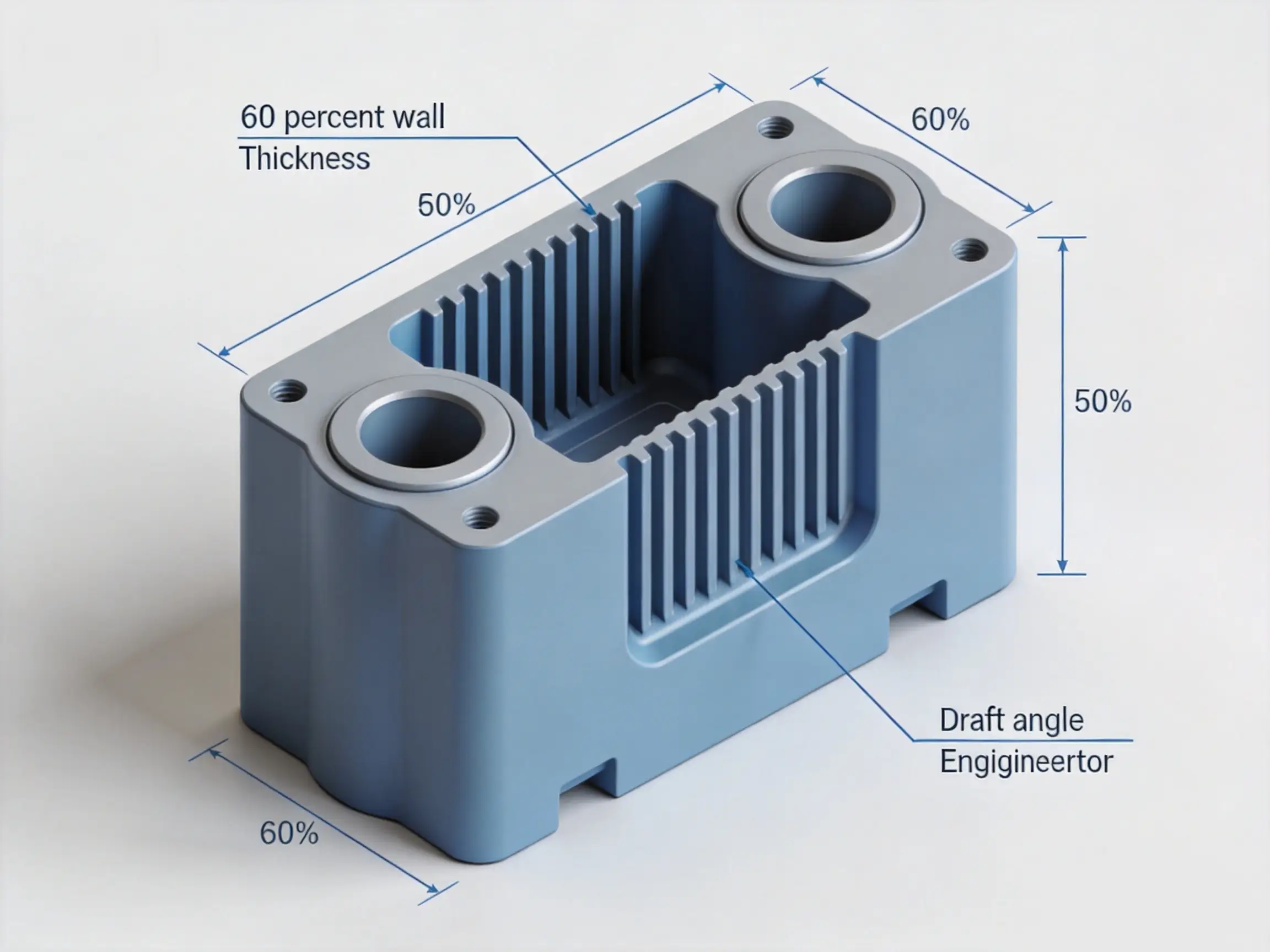
Ribs add bending stiffness without increasing wall thickness. A properly designed 2 mm rib adds more bending resistance than increasing the entire wall from 2 mm to 3 mm — at a fraction of the weight and cycle time cost.
But ribs are where first-time hardware founders make the most mistakes. A rib that’s too thick creates a localized hot spot that produces sink marks on the cosmetic surface. A rib that’s too tall may not fill completely or may stick during ejection.
Rib design checklist:
- Thickness: 50–60% of nominal wall thickness (never exceed 60%)
- Height: Maximum 3× rib thickness
- Base fillet radius: Minimum 25% of rib thickness (reduces stress concentration)
- Draft angle: Minimum 0.5° per side (1° preferred)
- Spacing: Minimum 4× rib thickness between ribs
- Use multiple thin ribs instead of one thick rib for better stiffness-to-weight ratio
- At intersections: Core out material to maintain uniform wall thickness
Real-world example: A smart home device enclosure had a 2.5 mm nominal wall. The original design specified ribs at 2.0 mm (80% of wall) — resulting in visible sink marks on the exterior surface. Reducing rib thickness to 1.3 mm (52% of wall) eliminated the sinks entirely while maintaining equivalent structural rigidity.
For a deeper dive into how these principles apply alongside other DFM considerations, see our Design for Manufacturing best practices guide.
Rule 4: Size Bosses Correctly for Assembly
Bosses are cylindrical features used for screw attachment, press-fit inserts, or alignment of mating parts. They appear in nearly every consumer electronics enclosure.
Boss design parameters:
| Parameter | Recommended Value |
|---|---|
| Boss wall thickness | ≤ 60% of nominal wall |
| Outer diameter | 2.0–2.5× screw diameter |
| Chamfer at top | 0.3–0.5 mm (aids screw insertion) |
| Base fillet radius | ≥ 0.25× wall thickness |
| Height-to-diameter ratio | ≤ 3:1 (add gussets for taller bosses) |
Key practices:
- Use ribs or gussets to reinforce tall bosses (height > 2× diameter)
- For threaded connections, specify metal insert nuts rather than molding threads directly — they provide stronger, reusable fastening
- Maintain uniform wall thickness around the boss to prevent differential shrinkage
- Avoid placing bosses along edges where they create asymmetric shrinkage
When your mechanical design team reviews your enclosure, boss placement and sizing are typically among the first items addressed — because poorly designed bosses cause assembly problems that multiply across every unit in a production run.
Rule 5: Round All Corners with Proper Fillet Radii
Sharp interior corners are stress concentrators and flow obstacles. They can cause cracking under load, create weld lines where plastic flow fronts meet, and concentrate stress in the mold steel itself.
Fillet design rules:
- Inner corner radius: Minimum 0.5× wall thickness (prefer 0.75×)
- Outer corner radius: Inner radius + wall thickness
- Step transitions: Fillet length should be at least 3× the height difference
- Apply fillets everywhere — including at rib-to-wall junctions and boss bases
Impact: Proper fillets can reduce stress concentration by up to 80% compared to sharp corners. They also create a streamlined flow path for molten plastic, reducing the risk of short shots and weld lines.
Rule 6: Minimize Undercuts — Or Plan for Side-Actions
An undercut is any feature that prevents the part from being ejected in a straight line along the mold opening direction. Side holes, reverse angles, and internal lips all create undercuts.
The cost of an undercut:
- Side-action (slider) mechanism: adds $3,000–$8,000 to mold cost
- Lifter mechanism for internal undercuts: adds $2,000–$5,000
- Additional maintenance and potential failure points in production
How to eliminate undercuts:
- Redesign the part geometry — Can the feature be achieved with a pass-through core instead of a side hole?
- Use shut-off surfaces — Mold cavity and core can meet to create holes without side-actions
- Split the part — Redesign as two simpler parts that snap together
- Accept forced ejection — For shallow undercuts in flexible materials (PP, PE), the part can sometimes snap out of the mold
Rule of thumb: If a feature requires a side-action, it should add at least 20% functional value to justify the tooling cost and complexity. Otherwise, redesign it out.
Rule 7: Choose Materials That Match Your Application AND Your Mold
Material selection and mold design are deeply intertwined. Different materials have different shrinkage rates, flow characteristics, and processing temperatures — all of which affect how your mold must be designed.
Material selection framework for injection molding:
| Application Need | Best Material | Why |
|---|---|---|
| Consumer electronics housing | ABS or PC/ABS | Impact-resistant, excellent surface finish, easy to paint |
| Transparent or high-impact parts | Polycarbonate (PC) | Crystal clear, virtually unbreakable |
| Chemical-resistant containers | Polypropylene (PP) | Inert to most chemicals, living hinges |
| Gears, bearings, sliding parts | Nylon (PA6/PA66) | Low friction, excellent wear resistance |
| Outdoor/UV-exposed products | ASA or UV-stabilized ABS | Maintains color and strength in sunlight |
| High-temperature components | Glass-filled Nylon (PA66+GF) | Heat deflection >150°C, metal-like stiffness |
| Medical device housings | Medical-grade PC or ABS | Biocompatible, sterilization-resistant |
Critical material-to-mold considerations:
- Shrinkage rate: PP shrinks 1.5–2.5%, while PC shrinks 0.5–0.7%. Your mold dimensions must compensate.
- Melt flow index (MFI) : Thin-walled parts need high-MFI materials that flow easily into tight spaces.
- Processing temperature: PC requires 280–320°C mold temperatures; PP works at 30–60°C. This affects mold steel selection and cooling system design.
For a broader view of how material choices fit into the full product development workflow, explore OPD’s end-to-end product development services.
Rule 8: Design for Consistent Ejection
Ejection is the moment of truth — when the mold opens and your part must release cleanly, without bending, cracking, sticking, or cosmetic damage.
Ejection design considerations:
- Ejector pin placement: Plan pin locations on non-cosmetic surfaces. Pin marks on visible surfaces ruin the finish.
- Pin size and number: More, smaller pins distribute force better than fewer, larger pins. Minimum pin diameter should be 3 mm for most engineering plastics.
- Ejection surface area: The total ejector area should be sufficient to keep ejection pressure below the material’s compressive strength. Too few pins = white marks or cracking.
- Stripper plates: For deep, thin-walled parts (cups, enclosures), a stripper plate provides uniform ejection force around the entire perimeter — far superior to individual pins.
- Mold temperature: Proper cooling time ensures the part is rigid enough to eject without deformation. Rushing cooling to save cycle time is a false economy.
Common Injection Molding Defects and How Design Prevents Them
Most production defects in injection molding can be traced back to design decisions made months earlier. Here’s how proper injection molding design guidelines prevent the most costly problems:
| Defect | Root Cause | Design Prevention |
|---|---|---|
| Sink marks | Thick sections cool slower, pull surface inward | Keep ribs ≤ 60% of wall; core out thick areas |
| Warpage | Uneven cooling from inconsistent walls | Maintain ±25% wall variation; add ribs for strength |
| Weld lines | Two flow fronts meet at weak point | Reposition gates; add vents; increase wall at junction |
| Short shots | Material can’t fill thin features | Increase wall thickness at thin areas; improve gate location |
| Flash | Mold doesn’t seal; material escapes parting line | Reduce injection pressure; ensure adequate clamp force |
| Air traps | Air can’t escape as mold fills | Add vents at flow endpoints; redesign fill path |
| Burn marks | Trapped air compresses and ignites | Improve venting; reduce injection speed at traps |
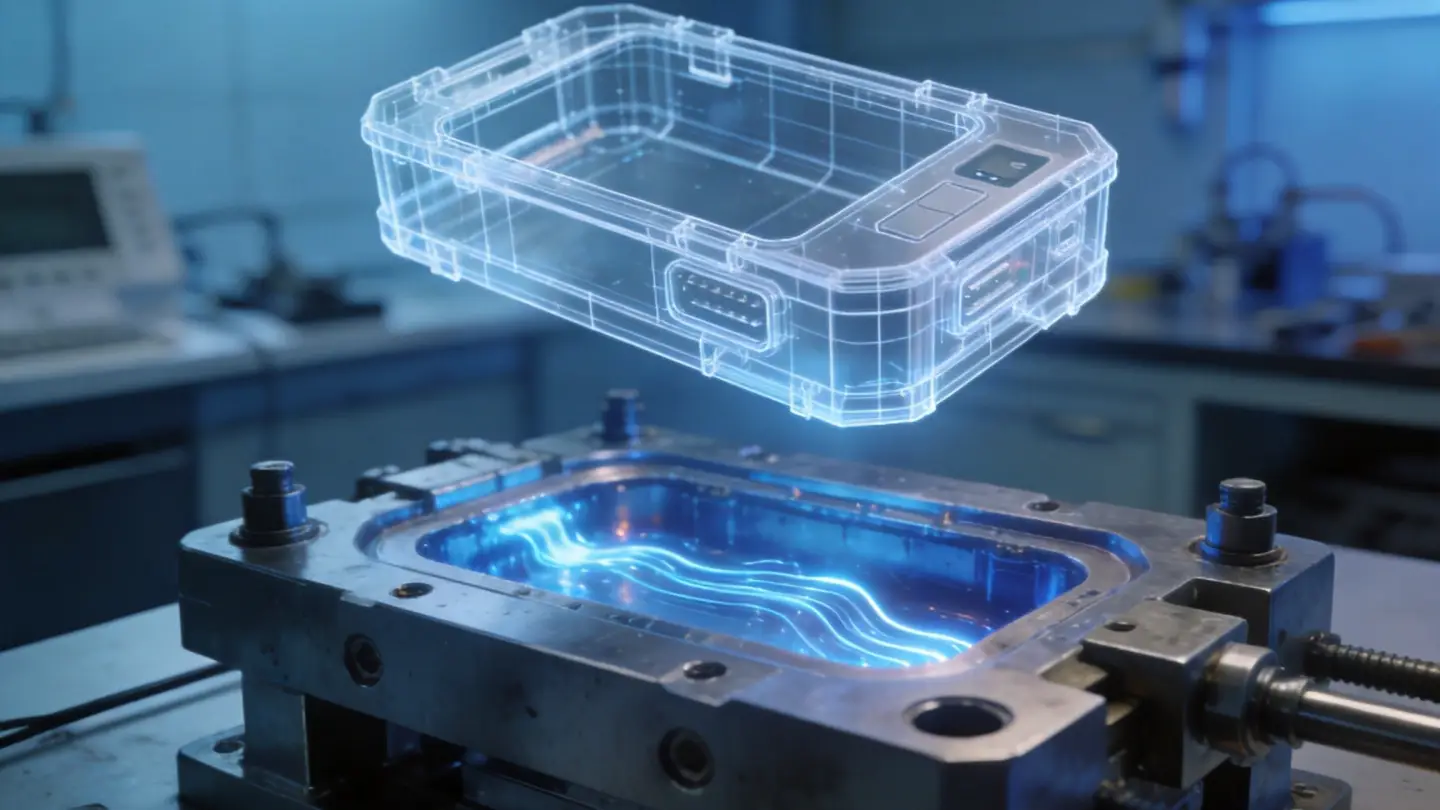
Pro tip: Request a mold flow analysis (Moldflow or Autodesk Simulation) from your manufacturing partner before cutting steel. This simulation predicts exactly where plastic will flow, where air will trap, and where weld lines will form — allowing you to fix design issues in CAD, not in steel.
Injection Molding Pre-Tooling Checklist
Before sending your design files to any mold development partner, run through this checklist:
- Wall thickness is uniform (±25% of nominal) across all sections
- Draft angles are applied to all vertical surfaces (minimum 0.5°, preferred 1.5–2°)
- Rib thickness is 50–60% of nominal wall thickness
- Rib height does not exceed 3× rib thickness
- Boss wall thickness is ≤ 60% of nominal wall
- All interior corners have fillet radii (minimum 0.5× wall thickness)
- No unnecessary undercuts — side-actions justified by function
- Material selected and matched to application requirements (mechanical, thermal, regulatory)
- Ejector pin locations planned on non-cosmetic surfaces
- Parting line location defined on non-visible edges where possible
- Gate location considered to minimize weld lines on cosmetic surfaces
- Tolerances specified only where functionally required (±0.1 mm is standard; tighter = more expensive)
- Mold flow analysis reviewed and design issues resolved in CAD
- DFM review completed with your manufacturing partner
This checklist mirrors what experienced mold development teams evaluate during their initial design review. Completing it before your first DFM meeting saves time on both sides and accelerates your path to production-ready tooling.
FAQ: Injection Molding Design Guidelines for Hardware Founders
What is the minimum wall thickness for injection molding?
For most engineering thermoplastics, the minimum practical wall thickness is 0.8 mm. However, the recommended minimum depends on the material and part size. Glass-filled materials typically require at least 2.0 mm minimum wall thickness due to restricted flow. Very thin walls (<1.0 mm) require high injection pressure and may result in incomplete filling (short shots).
How much draft angle do I need for textured surfaces?
For light textures (EDM finish, light sandblast), add a minimum of 1.0° draft. For medium textures, 1.5–3° is recommended. For deep or aggressive textures, plan for 3–5° or more. A general rule: add approximately 1° of extra draft for every 0.025 mm of texture depth.
Can I mold threads directly in injection molding?
Yes, but it requires either unscrewing mechanisms (expensive, slow) or collapsible cores (complex tooling). The more practical approach is to mold a boss hole and use a threaded metal insert — either press-fit, ultrasonically welded, or heat-staked. This provides stronger, more reliable threads at lower tooling cost.
What’s the difference between a mold and a tool?
In injection molding terminology, “mold” and “tool” are used interchangeably. Both refer to the steel assembly that shapes molten plastic into the final part. A mold consists of two halves: the cavity (A-side, typically the cosmetic surface) and the core (B-side, typically the functional side with ejector pins).
How do I know if my design is ready for injection molding?
Run through the pre-tooling checklist above, then request a formal DFM review from your manufacturing partner. A professional DFM review will analyze wall thickness, draft angles, undercuts, gate placement, ejector strategy, and material suitability — typically delivered as a detailed report with specific recommendations within 3–7 business days.
Get Your Injection Molding Design Right Before Tooling
Injection molding design guidelines aren’t just theoretical best practices — they’re the difference between a smooth production run and an expensive cascade of mold modifications, delayed shipments, and compromised product quality.
At OPD Design, our mechanical and mold development teams apply these principles every day for hardware founders building consumer electronics, IoT devices, smart home products, and medical devices. From initial DFM analysis through prototype tooling to mass production, we ensure your design is optimized for manufacturing before a single piece of steel is cut.
Ready to move your plastic part design toward production?