
Cleaning a cat litter box is a repetitive household task, but automating it creates a complex product-design challenge. A smart litter box must operate around a living animal, handle litter and waste, control odor, remain easy to clean, and communicate clearly with an owner who may be away from home.
The product cannot be treated as a conventional appliance. Cats may enter unexpectedly, hesitate around unfamiliar sounds, scatter litter into mechanisms or refuse to use an enclosed space that does not feel comfortable. Owners, meanwhile, need confidence that automated movement will not begin at the wrong time and that every waste-contact component can be maintained hygienically.
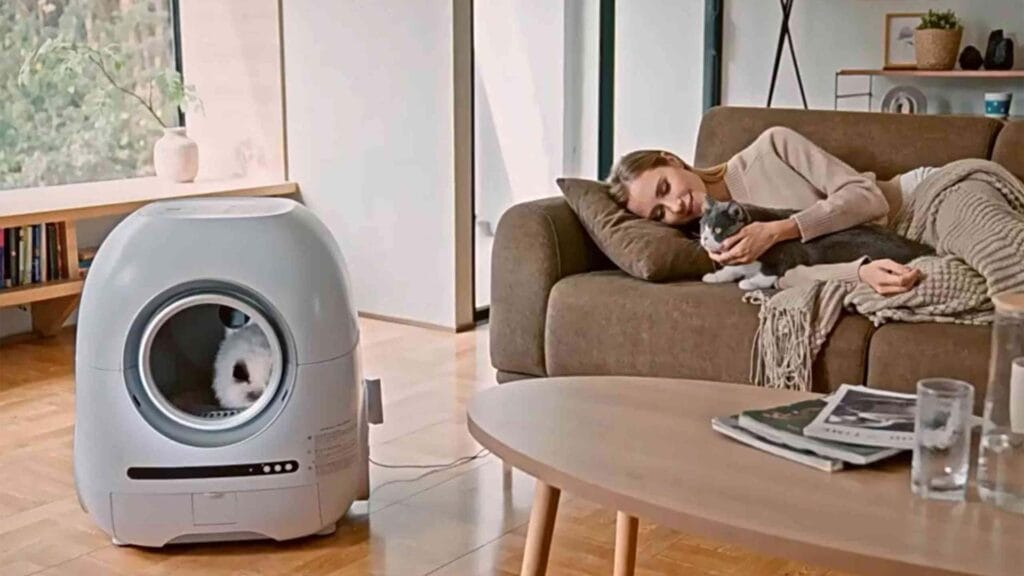
For a client in the United Kingdom, OPD developed a smart cat litter box combining industrial design, mechanical engineering, electronic design and functional prototyping. The project addressed common problems associated with traditional litter management: frequent manual cleaning, odor, inconvenient waste handling and limited visibility into a cat’s toileting routine.
This smart litter box design case study explains how OPD translated those problems into an integrated product system built around safety, automation, cleaning, connected control and daily pet care. Project information is based on OPD’s published Smart Litter Box project.
Project at a Glance
| Project element | Details |
|---|---|
| Product | Smart cat litter box |
| Client market | United Kingdom |
| OPD services | Industrial design, mechanical design, electronic design and functional prototyping |
| Primary users | Cats and pet owners |
| Main challenges | Safe automation, waste handling, odor control, cleaning and remote monitoring |
| Connected functions | App control, video monitoring and toileting statistics |
| Development approach | Integrated product, structure, hardware, firmware, software and prototype testing |
The project required the physical device and digital experience to work as one system. A mechanical cleaning cycle, for example, is not complete until sensors confirm safe conditions, firmware controls the sequence, the device reports its status and the owner understands the result.
The Product Challenge
Traditional litter boxes are mechanically simple, but they place most of the work on the owner. Waste must be removed manually, litter must be replaced, odors must be managed and changes in toileting habits can be easy to miss.
Automation can reduce that workload, but it introduces new risks and design requirements.
Safety Around an Unpredictable User
A cat does not follow an operating manual. It may enter during a cleaning sequence, remain inside longer than expected, investigate a moving part or place only part of its body within a sensor area.
The device therefore needs multiple layers of detection and controlled movement rather than relying on a single assumption about cat behavior.
Waste, Dust and Contamination
Cat litter creates fine dust and irregular particles. Waste adds moisture, odor and biological contamination. These materials can enter seams, block mechanisms, reduce sensor performance and make conventional appliance structures difficult to clean.
Conflicting Owner Expectations
Owners want automation, but they also want direct control. They want an enclosed, odor-managed product that still feels open enough for the cat. They want more data, but they do not want complicated setup or unclear health conclusions.
Mechanical and Digital Interdependence
Motors, sensors, ventilation, bagging, video, data and app control must share power, space and control logic. Changing one subsystem can affect noise, airflow, size, heat, service access and cost.
Defining the Design Goals
Based on the project background, the development team focused on several connected goals:
- Protect the cat during automated operation
- Reduce the owner’s repetitive cleaning workload
- Simplify litter replacement and waste disposal
- Support odor and air management
- Make deep cleaning practical
- Enable remote visibility and control
- Record toileting patterns for owner awareness
- Create a product suitable for everyday home environments
These goals shaped both the product architecture and the user experience.
From Pain Points to Product Functions
The final feature set mapped specific owner and pet-care problems to coordinated product responses.
| User or product need | Design response described in the project |
| Prevent operation when a cat may be at risk | Multi-layer sensor-based safety monitoring |
| Check the product while away | App-based remote video operation |
| Reduce litter replacement effort | One-touch litter replacement workflow |
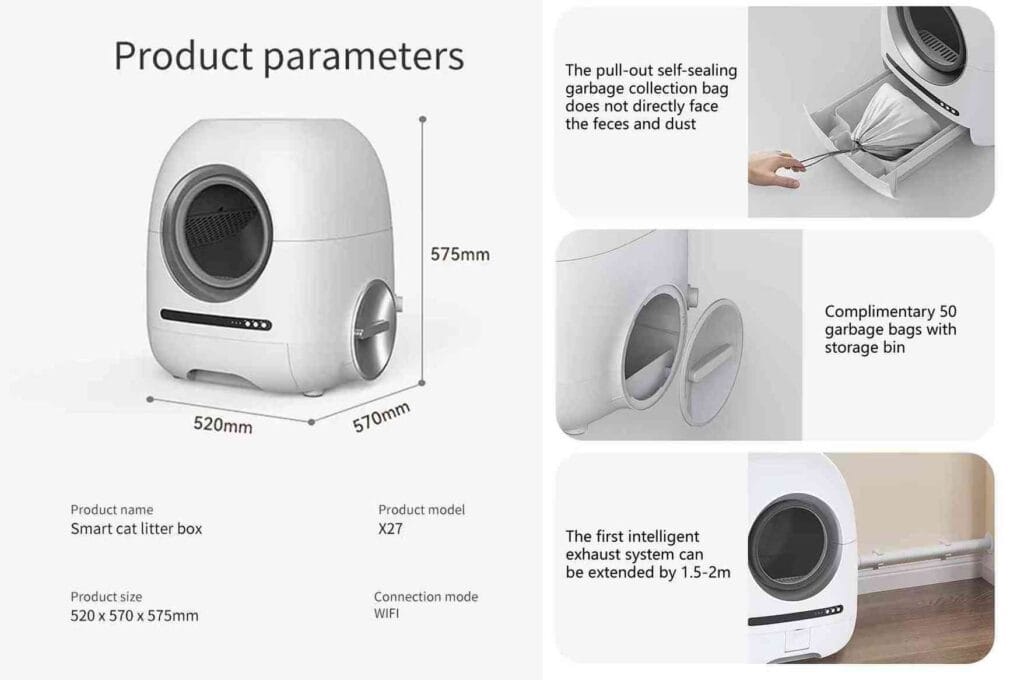
| Simplify contact with waste | Slide-out waste system with automatic bag sealing |
| Manage odor and air quality | Negative-ion treatment and intelligent ventilation |
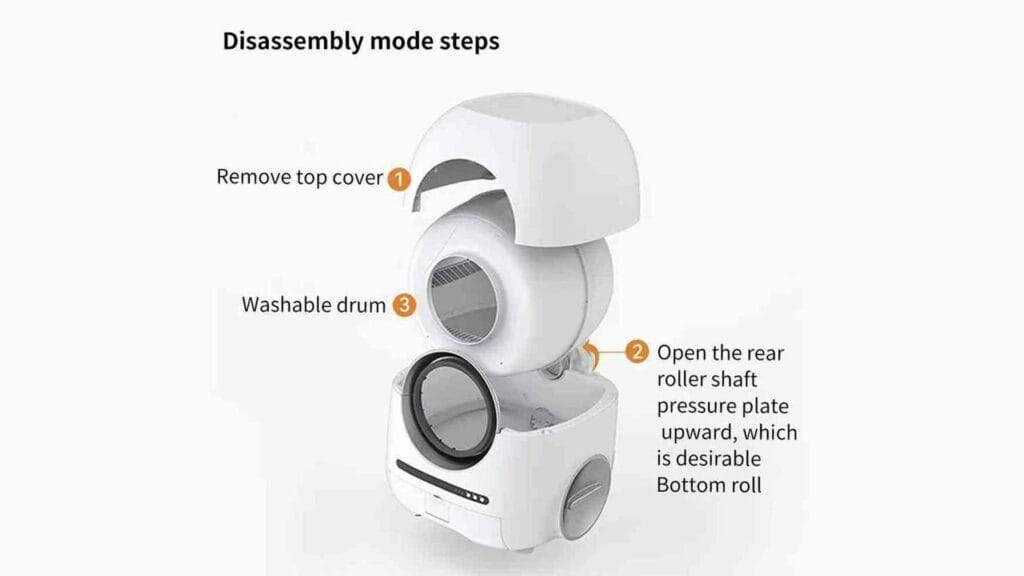
| Enable deep maintenance | Modular, easy-disassembly construction |
| Understand changes in routine | Toileting habit statistics and data analysis |
The value came not from one feature in isolation, but from how these functions supported a complete litter-care cycle.
Design Solution 1: Multi-Layer Safety Monitoring
Safety is the central design requirement for any self-cleaning litter box. The product contains moving mechanisms near an animal that may enter without warning.
According to the project page, advanced sensors continuously monitor the cat’s movement to help prevent injury or entrapment. A multi-layer approach is important because no single sensor or software condition should carry the entire safety function.
Designing Safety as a System
A robust architecture may need to consider:
- Cat entry and exit
- Partial entry
- Weight or movement changes
- Obstruction in the mechanism
- Unexpected return during a delayed cycle
- Sensor contamination
- Power loss
- Communication loss
- Motor overload
Detection is only the first step. Firmware must convert the sensor information into safe behavior, such as delaying, stopping or preventing a mechanism from moving.
The physical design should also reduce harm if electronic controls fail. Clearances, accessible gaps, motor force, moving speed, emergency release and stable geometry all contribute to safety.
Avoiding a Single Point of Confidence
A status message saying “cat not detected” is not meaningful unless the detection coverage and failure modes are understood. Litter dust, fur, waste and incorrect assembly can affect sensors.
This is why smart litter box safety should be evaluated through:
- Multiple representative cats and body positions
- Sensor coverage mapping
- Deliberate obstruction tests
- Contamination tests
- Power interruption
- Firmware fault simulations
- Repeated cycle testing
- Owner misuse and reassembly scenarios
The project included functional, performance, safety and user-experience testing across multiple prototype rounds, allowing the team to refine the system rather than depending on a single demonstration.
Design Solution 2: Remote Video and App Control
The dedicated app allows owners to monitor their cat’s bathroom behavior remotely. Video provides context that a simple notification cannot: owners can check whether the cat approached, entered or left the product and whether the device appears ready for use.
Connecting Device State With Owner Understanding
Remote operation introduces an important communication challenge. The app should distinguish between:
- A command being requested
- The device receiving the command
- Safety conditions being checked
- The mechanism operating
- The operation completing
- An error preventing completion
If an app displays success before the physical action is confirmed, the owner may believe the litter has been replaced or waste has been processed when it has not.
Privacy and Security Considerations
A pet camera can capture people, voices and the interior of a home. Product development should therefore address:
- Secure account access
- Household sharing permissions
- Encryption
- Camera status indication
- Data retention
- Device ownership transfer
- Firmware and app updates
- Account and video deletion
These issues are part of the product architecture, not only the privacy policy.
Design Solution 3: One-Touch Litter Replacement
Replacing litter can require lifting, pouring, cleaning and managing dust. The project introduced an intelligent system that detects the need for fresh litter and allows the owner to initiate the replacement process through the app.
The apparent simplicity of one-touch operation depends on complex coordination among:
- Litter-level or usage detection
- Mechanical movement
- Motor load management
- Safe cat detection
- Waste routing
- Status feedback
- Error recovery
Designing for Real Litter Variation
Litter differs in particle size, shape, density, clumping behavior, dust and moisture absorption. Mechanical prototypes should be tested with the intended range rather than one clean laboratory material.
Potential failure modes include:
- Bridging or blockage
- Material accumulating in corners
- Fine dust entering bearings or sensors
- Wet clumps increasing motor load
- Incomplete discharge
- Litter escaping into the room
The replacement workflow should also define what owners do when the cycle cannot finish. Accessible maintenance and understandable recovery are as important as automatic operation.
Design Solution 4: Slide-Out Waste Handling and Automatic Bag Sealing
Waste disposal is one of the least pleasant parts of litter box ownership. The project uses a slide-out structure with automatic bag sealing to reduce direct handling and make disposal more hygienic.
Mechanical Convenience With Contamination Control
The waste module has to support several needs:
- Easy access for the owner
- Controlled odor release when opened
- Reliable bag placement
- Sealing consistency
- Resistance to leaks and sharp litter particles
- Clear indication when the bag is full
- Prevention of incorrect reinsertion
An effective slide-out design should guide the component into its correct position and confirm that the system is ready before automated cycles resume.
Designing the Consumable Experience
If the system uses dedicated bags or sealing materials, the development team should consider availability, replacement frequency, storage and long-term cost. A convenient mechanism can become a customer-support problem if consumables are difficult to install or obtain.
Design Solution 5: Negative-Ion Odor Treatment
The product integrates negative-ion treatment as part of its approach to unpleasant odors and air management. Because the subsystem operates close to litter, waste, pets and owners, its placement, airflow and operating logic must be integrated with the complete enclosure.
Odor performance depends on more than the air-treatment component. Waste storage, seams, airflow paths, cleaning frequency, litter type and room conditions can all influence the owner experience.
Claims Require Evidence
Odor reduction, air purification, antibacterial or sterilization statements should be supported by product-specific test methods and results appropriate to the intended market. A component specification alone does not prove the complete product’s performance under real contamination and airflow conditions.
The user interface should also avoid presenting inferred air-quality states with more precision than the sensing system can support.
Design Solution 6: Intelligent Ventilation
The project uses adaptive ventilation that responds to humidity and odor conditions rather than operating continuously at one fixed level. This allows airflow to be managed according to the litter box environment.
Balancing Airflow, Noise and Energy
Ventilation design affects:
- Odor removal
- Noise near the cat
- Energy consumption
- Dust movement
- Filter or air-path maintenance
- Moisture accumulation
Stronger airflow is not automatically better. Excessive noise may discourage a cautious cat, while poorly controlled airflow may move litter dust into mechanisms or the surrounding room.
Sensors, fan placement, ducts and control algorithms must therefore be evaluated together.
Design Solution 7: Modular Disassembly for Deep Cleaning
Automation does not eliminate cleaning. It changes where contamination accumulates and how owners reach it.
The project uses modular construction so major parts can be removed for deeper maintenance. This decision connects industrial design, mechanical layout, sealing, electronics and owner usability.
Designing the Complete Cleaning Workflow
The team needed to consider more than whether a component could be removed. The owner must be able to:
- Stop and make the product safe
- Identify which parts can be washed
- Remove them without contacting hidden waste
- Clean and dry them effectively
- Reinstall them in the correct orientation
- Confirm that the device is ready to operate
Potential design risks include:
- Water reaching electronics
- Seals being lost or folded
- Parts being reinstalled backward
- Wet parts causing odor or sensor problems
- Fine litter remaining in inaccessible cavities
- Cleaning chemicals damaging coatings or markings
Good modularity uses clear interfaces, limited part count and physical features that prevent incorrect assembly.
Maintainability Supports Product Life
A difficult-to-clean product may work well during demonstrations and degrade in the field. Dust, waste and hair can increase friction, block airflow and cover sensors.
By prioritizing maintainability during mechanical design, the project addressed reliability and hygiene together rather than treating cleaning as an instruction-manual issue.
Design Solution 8: Toileting Habit Statistics
The smart litter box tracks and analyzes toileting behavior so owners can observe patterns over time. Unlike a traditional box, a connected system can potentially record events such as visit frequency, timing and duration, depending on the final sensor architecture.
Turning Events Into Understandable Information
Raw sensor events are not automatically useful. The system must distinguish among:
- A cat entering to use the box
- Brief investigation
- Multiple movements during one visit
- Different cats in a multi-cat home
- Cleaning or owner interaction
- Sensor noise
Firmware and backend logic need clear event definitions before the app can present meaningful statistics.
Supporting Awareness Without Overclaiming
Changes in litter-box behavior can be useful for owner awareness, but product data should not be presented as a veterinary diagnosis unless the claims and evidence support that use.
A responsible interface should:
- Show trends and data quality
- Explain limitations
- Identify missing or uncertain events
- Avoid false certainty
- Encourage appropriate veterinary consultation when owners have concerns
This approach supports scientific pet care while maintaining realistic expectations about what the device measures.
Industrial Design: Balancing Cat Comfort and Home Integration
OPD’s industrial design team studied cat behavior and owner needs to develop a form intended to support both animal comfort and household convenience.
Designing for the Cat
Relevant considerations include:
- Entrance size and height
- Interior movement space
- Stable footing
- Visibility and perceived enclosure
- Noise and vibration
- Litter depth and access
- Ability to enter and exit without obstruction
A mechanically efficient form can still fail if a cat feels trapped, cannot turn comfortably or avoids the entry.
Designing for the Owner
Owner needs include:
- Reasonable floor footprint
- Access to removable modules
- Clear controls and status
- Easy filling and waste removal
- Compatibility with the home environment
- Manageable installation and transport
The exterior design also communicates whether the product feels clean, safe and trustworthy. Because litter boxes remain visible in many homes, the product must integrate into domestic interiors without hiding important functional information.
Mechanical Design: Creating a Durable, Maintainable System
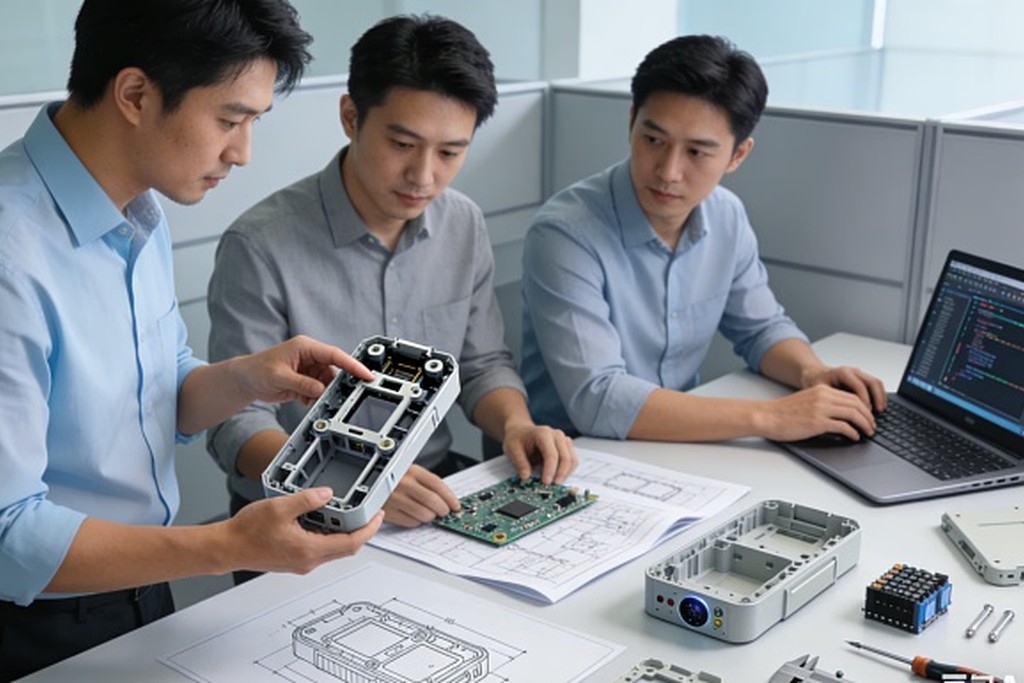
After the design direction was established, OPD engineers refined the internal structure using CAD. Precision fit, efficient operation, durability and maintainability were key project considerations.
Mechanism Development
Automatic litter handling needs predictable movement despite irregular material. Mechanical development should account for:
- Litter weight and distribution
- Wet clumps and waste
- Motor torque
- Friction and wear
- Obstruction
- Litter escaping into joints
- Tolerance stack-up
- Cleaning and service access
Functional rigs can isolate the mechanism before it is integrated into the complete enclosure. Later prototypes test how the mechanism behaves with sensors, electronics, real litter and repeated use.
Structural Stability
The product must remain stable when a cat enters, exits, scratches or pushes against it. Its center of gravity, base geometry and internal movement should not create tipping or unwanted motion.
Design for Assembly
A smart litter box contains large molded parts, electromechanical modules, seals, cables and removable components. Mechanical design must support both factory assembly and owner maintenance.
Useful principles include:
- Clear cable routing
- Accessible fastening
- Controlled gasket compression
- Error-proof part orientation
- Replaceable service modules
- Reduced part count
- Test access
These choices reduce production variation and improve long-term support.
Electronic Hardware: Sensors, Control and Communication
The project integrated electronic components, custom controllers and communication modules to support sensing, automation and connected functions.
Sensor Integration
Safety and data functions depend on sensor placement, coverage and environmental resistance. Sensors may need to operate around:
- Litter dust
- Fur
- Moisture
- Variable cat body sizes
- Moving mechanisms
- Cleaning and reassembly
Sensor performance should be evaluated inside the final geometry. A sensor that works on a bench may behave differently behind a window, near a motor or after dust accumulation.
Motor and Power Control
The controller must manage cleaning, litter replacement, bagging and ventilation sequences while monitoring loads and safety conditions.
Relevant functions include:
- Motor current monitoring
- Controlled acceleration and stopping
- Obstruction response
- State confirmation
- Safe power-loss behavior
- Event logging
- Recovery after interruption
Communication Hardware
Remote video and app features require reliable connectivity. Antenna performance can be affected by motors, wiring, large enclosures and the product’s position near walls or furniture.
The development team should test pairing and data communication in realistic home networks rather than relying only on an open laboratory environment.
Firmware: Coordinating the Physical Product
OPD developed firmware to control hardware accurately and exchange data with the software system.
For this product, firmware connects sensor information with mechanical actions. A simplified operating sequence may include:
- Detect activity
- Confirm that the cat has left
- Apply a safe delay
- Recheck sensor conditions
- Start the selected operation
- Monitor motor and obstruction data
- Stop or recover if a fault occurs
- Confirm completion
- Record and transmit the event
A State-Based Approach
Clear device states help prevent conflicting commands. The product may distinguish among idle, occupied, waiting, cleaning, replacing litter, waste-bin open, maintenance, fault and offline conditions.
Both firmware and app should use the same definitions so owners see an accurate representation of the physical device.
Update and Recovery
Connected products need controlled firmware updates. The system should protect essential operation if an update is interrupted and maintain compatibility among device, app and backend versions.
App and Backend Development
The mobile app and backend were designed to provide remote control, video monitoring and data analysis through a simple owner experience.
Prototyping and Testing
OPD completed multiple rounds of functional, performance, safety and user-experience evaluation to refine the prototype.
Functional Testing
Functional testing confirms that major subsystems perform their intended operations, including cleaning sequences, litter replacement, bag handling, ventilation, sensing, app commands and data reporting.
Performance Testing
Performance evaluation may cover:
- Cycle completion
- Motor load
- Sensor detection
- Litter movement
- Bag sealing
- Ventilation response
- App and video latency
- Data synchronization
Safety Testing
Safety testing should include normal use and foreseeable abnormal conditions:
- Cat re-entry
- Partial obstruction
- Sensor contamination
- Waste drawer removal
- Incorrect reassembly
- Power failure
- Network loss
- Motor overload
User-Experience Testing
Owners should be observed completing setup, remote control, waste disposal, cleaning and error recovery. Cat acceptance should be evaluated through voluntary behavior, approach, posture and repeated use rather than a single forced interaction.
Multiple prototype rounds allow findings to improve the next build before tooling and production make changes more expensive.
Designing for Manufacturing Readiness
Although this case page focuses on design and functional prototyping, a smart litter box intended for market must eventually translate into repeatable manufacturing specifications.
Key considerations include:
- Moldable part geometry
- Stable tolerances across large components
- Motor and sensor supplier quality
- Cable and seal assembly
- Production firmware programming
- Sensor calibration
- End-of-line functional testing
- Leak and obstruction checks
- Cosmetic inspection
- Packaging for a large product
Production Test Strategy
The factory needs efficient tests for critical functions. A production line cannot run every long-duration prototype experiment on every unit.
End-of-line tests may check:
- Sensor communication
- Motor direction and current
- Drawer and module detection
- Camera and connectivity
- Indicators and controls
- Firmware version
- Device identity
- Ventilation
- Abnormal sound
Longer reliability and cleaning tests can be performed on controlled samples based on an appropriate quality plan.
Pilot Production
A pilot build should use intended tooling, materials, suppliers, work instructions and inspection methods. It can reveal:
- Assembly interference
- Seal variation
- Cable damage
- Sensor alignment problems
- Litter leakage
- Excessive motor current
- Software provisioning errors
- Packaging damage
The production process should be adjusted and verified before volume increases.
Project Value
The completed smart litter box concept brings several aspects of daily cat care into one connected system:
- Automated litter and waste handling
- Layered protection around mechanical operation
- Reduced direct contact with waste
- Easier access for deep cleaning
- Adaptive odor and ventilation management
- Remote visibility and control
- Toileting behavior records for owner awareness
The project demonstrates OPD’s ability to integrate physical product design with electronics, firmware, app functions and backend services.
No single discipline could solve the product challenge independently. Cat safety depends on structure, sensors and control logic. Cleaning depends on industrial design, mechanical interfaces and material decisions. Remote operation depends on hardware confirmation, firmware states, cloud services and owner communication.
This integration is the central value of a full-system pet tech development approach.
Building a Safer and More Usable Smart Litter Box
This project shows that successful smart litter box design is not simply about automating waste removal. It requires a coordinated product system that respects cat behavior, reduces owner effort and remains understandable when something unexpected happens.
By combining industrial design, mechanical engineering, electronic hardware, firmware, software and iterative prototyping, OPD developed a solution around the complete pet-care workflow—from cat entry and safety monitoring to litter replacement, bag disposal, cleaning and remote owner awareness.
Explore the original OPD Smart Litter Box case for the project overview. If you are developing an automatic litter box, pet wearable, smart feeder, tracker or another connected pet product, learn more about OPD’s Pet Tech product development services or contact the team to discuss your idea.