
The 18-month trap is the structural reality that catches nearly every hardware startup founder: while your software competitors ship in weeks, you face 18 months of building infrastructure before your first product rolls off the line. This guide breaks down why hardware development is structurally slow, what kills startups during this period, and how to navigate the trap with the right strategies and partners.
| Factor | Software Startup | Hardware Startup |
|---|---|---|
| Time to first revenue | 2-4 weeks | 12-18 months |
| Initial investment | $5K-$50K | $150K-$500K+ |
| Key challenge | Product-market fit | Manufacturing infrastructure |
| Cost of iteration | Near zero | $10K-$100K per round |
| Infrastructure | Cloud services exist | Must be built from scratch |

Introduction: The Expression Nobody Warns You About
There is a particular expression that appears on the face of a hardware startup founder about nine months into their journey. It is not despair, exactly. It is the look of someone who has just realized that the rules of the game they are playing are fundamentally different—and that nobody mentioned this before they started.
The expression appears when the founder, who has raised a seed round, assembled a small team, designed a promising product, and begun to feel the first stirrings of commercial momentum, discovers that they cannot actually make anything.
Not because the design is wrong. Not because the team is incompetent. But because the physical infrastructure required to manufacture their product does not yet exist—and building it will take another year, cost more than the product development itself, and force a cascade of decisions that have nothing to do with engineering.
This is the Eighteen-Month Trap. And it catches nearly everyone. The concept of structural delays in hardware startups has been well-documented—yet most founders still underestimate its impact.
Why Hardware Is Structurally Slow
A software startup builds one thing: the product. The infrastructure already exists. AWS, Google Cloud, and Microsoft Azure provide computing, storage, networking, and deployment at virtually any scale, available in minutes, billed by the second. A software founder with a laptop and a credit card can go from idea to global product in weeks.
A hardware startup must build everything simultaneously:
- The product itself
- The manufacturing facility or production partner relationships
- The supply chain for hundreds of components
- The testing and certification infrastructure
- The quality control processes
- The logistics network for global distribution
While software “scales” by running more instances on existing servers, hardware scaling requires building new physical infrastructure for every order of magnitude increase in volume.
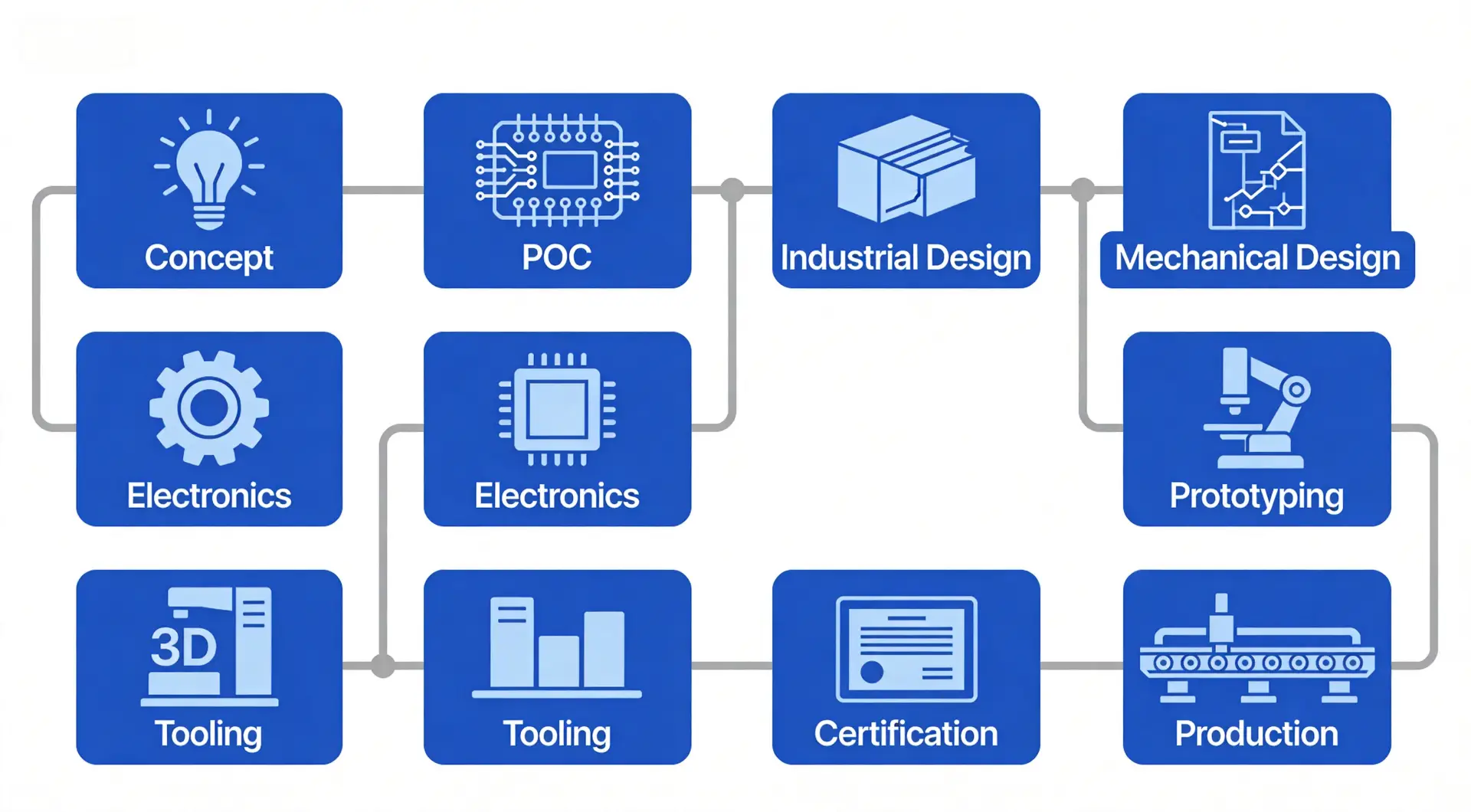
The Timeline Reality Check
From concept to first revenue, here is what you are actually facing
| Development Phase | Typical Duration | Key Activities |
|---|---|---|
| Concept & Planning | 1-2 months | Requirements, market research, initial design direction |
| Proof of Concept | 2-3 months | Breadboard prototypes, technology validation |
| Industrial Design | 2-3 months | Product form, user experience, CMF selection |
| Mechanical Design | 2-4 months | Internal structure, tooling design, DFM analysis |
| Electronics Design | 2-4 months | PCB design, component selection, firmware development |
| Prototype Iterations | 3-6 months | Alpha/beta builds, testing, design refinement |
| Tooling & Production Setup | 3-6 months | Mold fabrication, production line setup, pilot run |
| Certification | 2-4 months | FCC, CE, UL, and other required testing |
| Initial Production | 1-2 months | First manufactured units, quality validation |
| Total to Market | 12-24 months | Depending on complexity and revision cycles |
The Five Killers of Hardware Startups
Understanding why hardware startups fail starts with recognizing the five most common threats below.
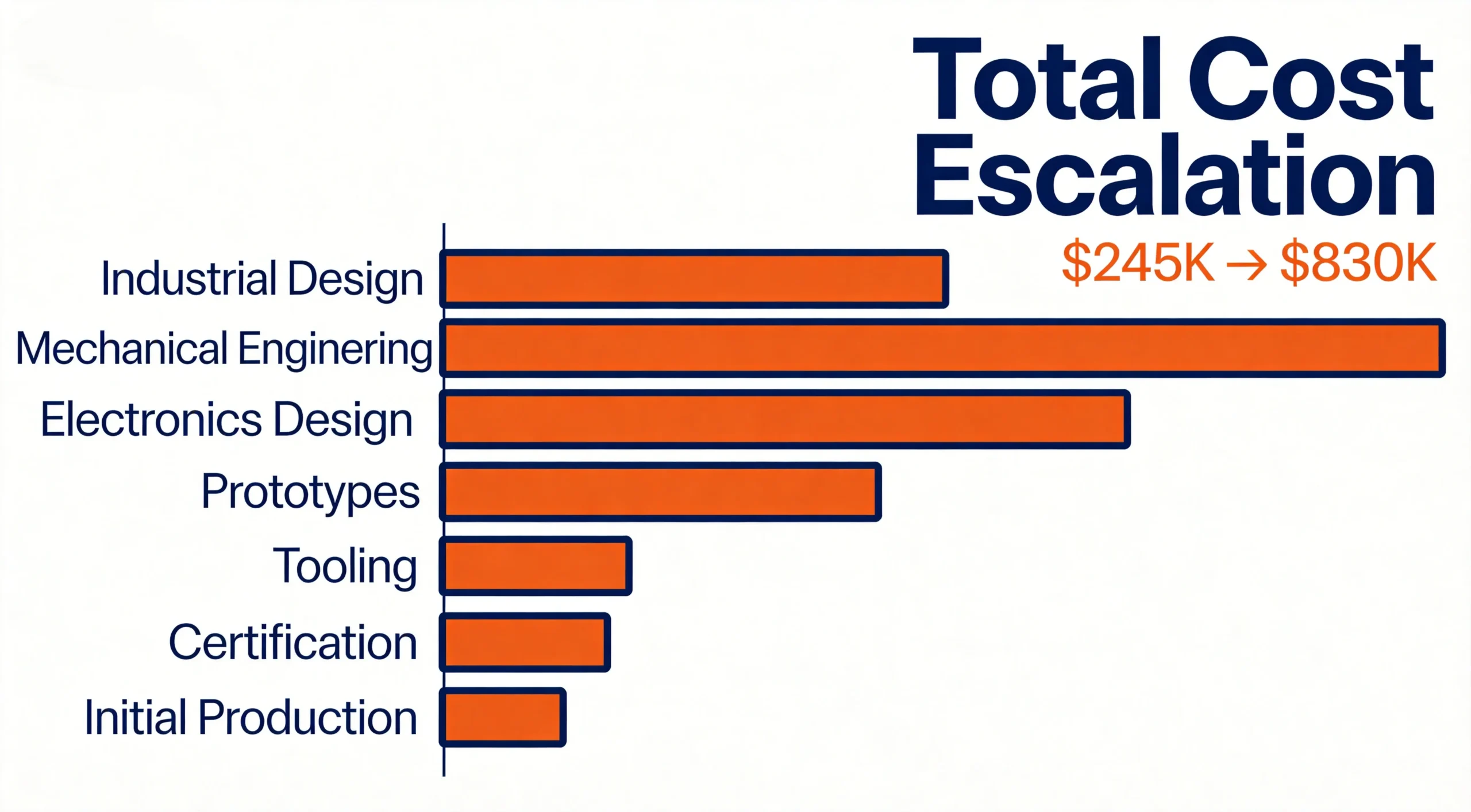
Killer #1: The Cost Escalation Spiral
Many founders base their budget expectations on the cost of a single prototype or the initial engineering estimate. But the journey from “it works on the bench” to “it’s ready to sell” is far longer and more expensive than most anticipate.
A realistic budget breakdown for a consumer electronics product:
| Cost Category | Low Estimate | High Estimate | What It Covers |
|---|---|---|---|
| Industrial Design | $15,000 | $50,000 | Concept development, 3D modeling, renderings |
| Mechanical Engineering | $20,000 | $60,000 | Structural design, DFM, tooling specifications |
| Electronics Design | $25,000 | $80,000 | PCB design, firmware, component sourcing |
| Prototypes | $30,000 | $100,000 | Multiple iterations, functional and cosmetic builds |
| Tooling | $50,000 | $200,000 | Injection molds, die casting, metal stamping |
| Certification | $15,000 | $50,000 | FCC, CE, UL, industry-specific testing |
| Initial Production | $50,000 | $150,000 | First batch, quality validation, packaging |
| Contingency (20-30%) | $40,000 | $140,000 | Unexpected delays, design changes, market shifts |
| Total | $245,000 | $830,000 |
The timeline problem compounds the cost problem. Every month of extended development means more burn: salaries, rent, and operational costs accumulate while no revenue comes in. A “six-month project” that becomes twelve months doesn’t just cost twice as much—it costs twice as much plus six months of operating expenses. For a detailed breakdown, see our guide on product development costs in China.
Real Case: One of our clients—a robotics startup with strong VC backing—estimated $200,000 for their first product. After three prototype iterations, tooling revisions, and unexpected certification delays, they spent $680,000 before shipping a single unit.
Killer #2: The “Working Prototype” Trap
A working prototype is a significant milestone, but it is far from a finished product. Many startups celebrate their prototype and assume they are almost done—only to discover that most of the work still lies ahead.
A prototype built from development boards, hand-soldered connections, and 3D-printed enclosures proves the concept works. But it tells you little about:
- Whether the product can be manufactured reliably at scale
- Whether it will pass certification testing
- Whether it will survive real-world use conditions
- What it will actually cost at volume
- How long assembly will take in a factory setting
- Whether components will remain available for the product lifetime
The gap between prototype and production is often called the “Valley of Death” for good reason. Understanding the EVT, DVT, and PVT product development stages can help you bridge this gap systematically. Transforming a bench prototype into a manufacturable, certifiable, reliable product requires a different set of skills and often as much effort as creating the prototype in the first place. Professional product prototyping services can bridge this gap by applying production-grade processes to early-stage builds.
Common Prototype-to-Production Gaps
表格
| Issue | Prototype Reality | Production Reality |
|---|---|---|
| PCB assembly | Hand-soldered, reworkable | Automated SMT, no rework |
| Enclosure | 3D printed, tolerances ±0.3mm | Injection molded, tolerances ±0.05mm |
| Power consumption | Bench power supply, stable | Battery, variable conditions |
| Wireless performance | Open air, ideal placement | Real-world interference, material effects |
| Temperature range | Room temperature testing | -10°C to 45°C operational range |
| Drop/shock | Gentle handling | Shipping and handling abuse |
Killer #3: Supply Chain Fragility
Hardware products involve hundreds of components, each with its own supplier, lead time, and risk profile. In 2026, supply chain volatility remains the norm, not the exception.
The average consumer electronics product contains:
- 50-200 unique electronic components
- 10-30 mechanical parts
- 5-15 materials and finishes
- 3-10 external suppliers minimum
One missing component—one supplier that cannot deliver—can halt your entire production line.
The Component Availability Problem
Component shortages that began in 2020 have eased for commodity parts but persist for specialized components. AI chips, advanced sensors, and specialized power management ICs remain allocation-controlled in 2026.
Before you finalize your design, verify component availability:
- Check lifecycle status: Is the part actively sold, or end-of-life?
- Verify second sources: Can you use an alternative if the primary is unavailable?
- Stock up strategically: Can you pre-buy enough for your projected volume plus 20%?
- Design for substitution: Can your PCB accept a pin-compatible alternative?
Killer #4: Certification Nightmares
Every market you sell in requires compliance with local regulations. For consumer electronics targeting the US and European markets, this typically means:
| Certification | What It Covers | Typical Cost | Timeline |
|---|---|---|---|
| FCC (USA) | Electromagnetic emissions | $5,000-$15,000 | 4-8 weeks |
| CE (Europe) | Safety, EMC, RoHS | $8,000-$25,000 | 6-12 weeks |
| UL (optional) | Product safety | $10,000-$30,000 | 8-16 weeks |
| REACH/RoHS | Hazardous substances | $3,000-$8,000 | 4-6 weeks |
Beyond these basics, specific product categories require additional certifications:
- Medical devices: FDA 510(k) or CE MDR (€50,000+, 12-18 months)
- Wireless products: FCC ID, CE RED (additional $10,000-$30,000)
- Children’s products: CPSIA compliance, tracking labels
- Industrial equipment: OSHA compliance, CE Machinery Directive
Critical Warning: Certification testing failures are common and costly. A product that fails EMC testing may require PCB redesign, enclosure modifications, or component changes—all of which cost time and money, and may require re-testing from scratch. Working with a partner experienced in compliance certification from the design phase can prevent most of these failures.
Killer #5: Team Capability Gaps
Engineering and industrialization talent is becoming even more scarce. The organizations that succeed will not necessarily be the ones with the best ideas, but the ones with access to the most experienced specialists.
Without system engineers, mechatronics experts, compliance specialists, and leaders in industrialization, innovation stalls in the prototype phase.
The biggest risk many companies face is that they simply do not know what they do not know. You do not know that your thermal simulation was done incorrectly. You do not know that your antenna placement will fail FCC testing. You do not know that your mold design will produce flash.
The Solution: Build a team or partner network that has done this before. Access to experienced industrial design expertise early in development can prevent costly downstream mistakes. Look for:
- Previous launches in your product category
- Experience with your target markets’ certifications
- Relationships with proven component suppliers
- Track record of transitioning from prototype to production
How to Navigate the 18-Month Trap
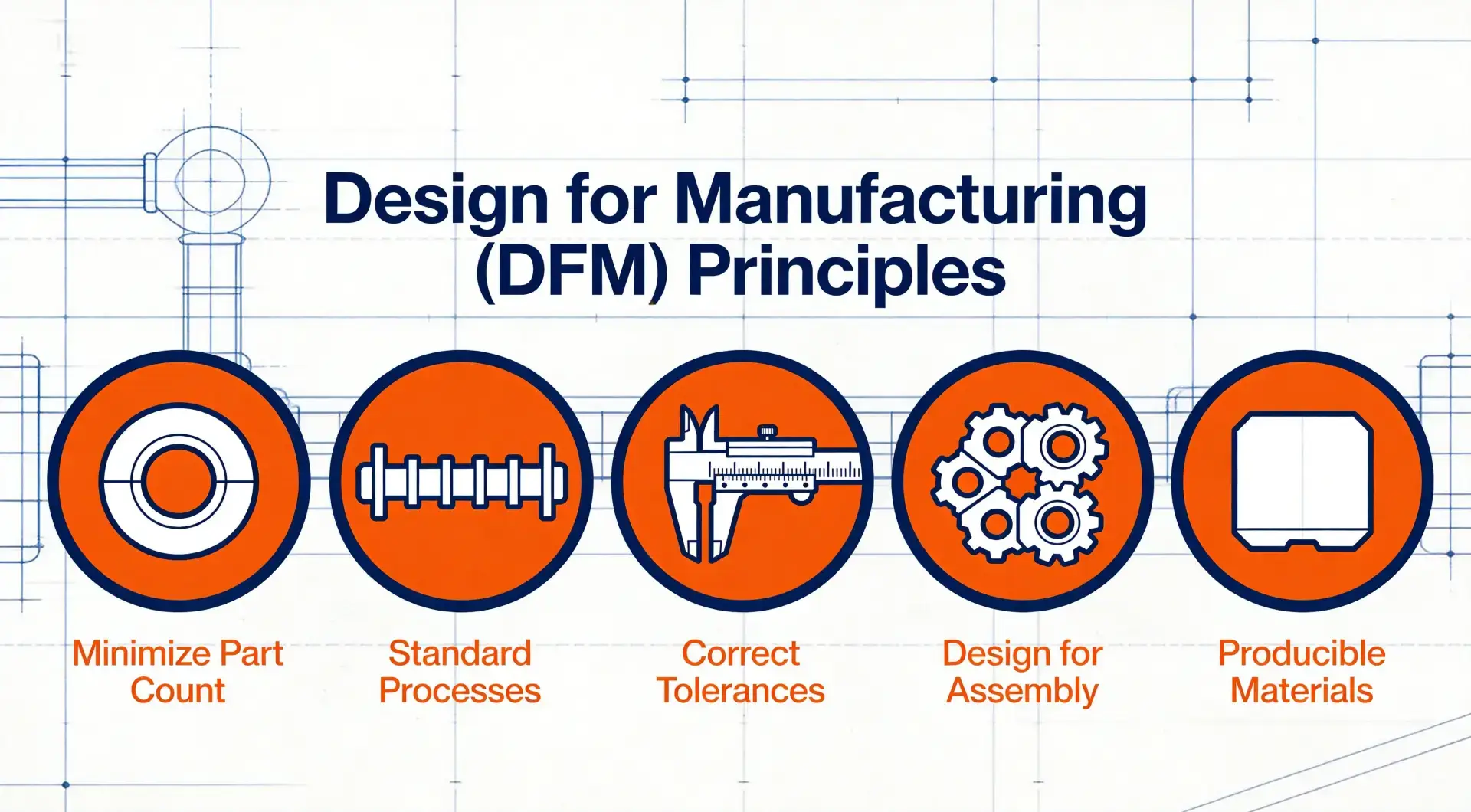
Strategy #1: Design for Manufacturing from Day One
The single biggest mistake hardware startups make is treating manufacturing as an afterthought. In 2026, with compliance requirements tightening and margin pressures increasing, this approach is fatal.
Design for Manufacturing (DFM) is not a checklist you run at the end of development—it is a mindset you apply from the first sketch.
Key DFM Principles for Hardware Startups
| Principle | Why It Matters | Common Mistakes |
|---|---|---|
| Minimize part count | Fewer parts = fewer failure points = lower assembly cost | Over-engineering with redundant components |
| Design for standard processes | Custom processes add cost and risk | Unusual geometries that require special tooling |
| Specify tolerances correctly | Tight tolerances add cost; loose tolerances cause failures | Over-specifying tolerances to “be safe” |
| Plan for assembly | DFM includes DFA (Design for Assembly) | Complex assembly sequences requiring skilled labor |
| Select producible materials | Material availability affects cost and timeline | exotic materials with long lead times |
For a comprehensive guide to DFM principles, see our article on DFM Best Practices for Hardware Founders. Our mechanical design services integrate DFM principles from the earliest design stages.
Strategy #2: Partner with Experienced Development Firms
Strategic partnerships have become the most reliable path to accessing experienced specialists without building an oversized internal team.
When evaluating development partners, look for:
1. End-to-End Capability
- Can they handle industrial design, mechanical engineering, electronics, and firmware?
- Or will you need to coordinate multiple vendors?
2. Manufacturing Transition Experience
- Have they successfully launched products into mass production?
- Do they have relationships with proven contract manufacturers?
3. Certification Expertise
- Are they familiar with FCC, CE, and other required testing?
- Do they have relationships with accredited testing laboratories?
4. Supply Chain Resources
- Can they help source components and manage suppliers?
- Do they have experience with the specific components your product requires?
OPD Design provides end-to-end product development services from concept to mass production, with proven experience launching products in the US, European, and Middle Eastern markets.
Strategy #3: Build Realistic Timelines and Budgets
The golden rule of hardware development: Add 50% to whatever timeline you initially estimate. Add 100% to whatever budget you initially estimate.
Why? Because:
- Prototypes always reveal new problems
- Suppliers always have delays
- Testing always uncovers issues
- Markets always shift
- Investors always push for faster delivery
The Contingency Framework
| Development Phase | Add This Much Contingency |
|---|---|
| Concept to prototype | 40% time, 50% budget |
| Prototype to production-ready | 60% time, 75% budget |
| Production launch | 30% time, 40% budget |
Strategy #4: Validate Early, Validate Often
Traditional hardware development follows a linear path: design complete, then prototype, then test. This approach maximizes the cost of changes—every issue discovered late costs 10-100x more to fix than the same issue discovered early.
Modern hardware development follows an iterative approach: validate early, validate often.
| Validation Stage | What to Test | Tools and Methods |
|---|---|---|
| Concept validation | Market demand, user needs | Interviews, surveys, landing pages |
| Technical validation | Feasibility, performance | Breadboards, simulations, analysis |
| Design validation | Form, fit, function | Rapid prototypes, 3D prints |
| Production validation | Manufacturability, yield | Pilot runs, DFM reviews |
| Compliance validation | Regulatory requirements | Pre-compliance testing, certified labs |
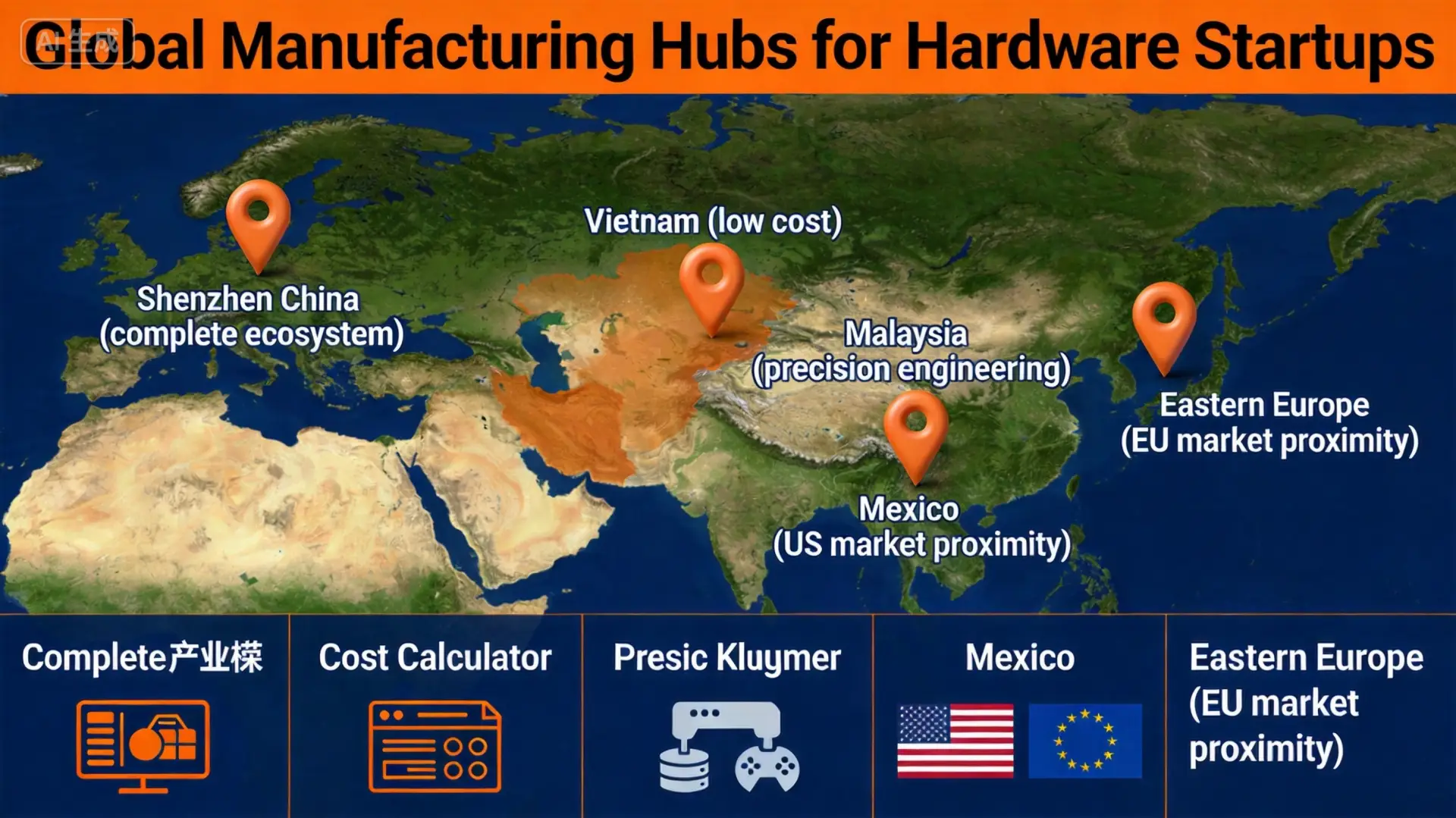
Strategy #5: Choose Your Manufacturing Geography Wisely
In 2026, the “factory of the world” narrative has evolved. While China remains the dominant manufacturing hub for complex electronics, the global manufacturing landscape is diversifying.
| Region | Strengths | Best For |
|---|---|---|
| Shenzhen, China | Complete ecosystem, fastest turnaround, lowest cost for volume | High-volume consumer electronics, complex assemblies |
| Vietnam | Lower labor costs, tariff mitigation | Simple assemblies, lower-complexity products |
| Malaysia | Precision engineering, electronics production | PCBA, precision components |
| Mexico | US market proximity, tariff advantages | Products targeting North America |
| Eastern Europe | EU market proximity | Products targeting European markets |
For most hardware startups targeting global markets, Shenzhen-based production remains the optimal choice for the first production run—provided you have a partner with strong manufacturing support capabilities who can navigate the ecosystem effectively.
The 18-Month Checklist: Your Survival Guide
Use this checklist to track your progress through the trap:
Month 1-3: Foundation Phase
- Define clear product requirements and success metrics
- Conduct market validation with potential customers
- Secure initial funding with realistic burn rate projections
- Identify target markets and required certifications
- Begin talent acquisition or partner selection
Month 4-6: Design Phase
- Complete industrial design with DFM considerations
- Begin mechanical and electronics design in parallel
- Start component research and second-source verification
- Identify potential contract manufacturers
- Begin regulatory research for target markets
Month 7-9: Prototype Phase
- Build and test first functional prototypes
- Conduct design reviews with manufacturing experts
- Begin FCC/CE pre-compliance testing
- Refine design based on prototype feedback
- Finalize component selection with confirmed availability
Month 10-12: Tooling and Preparation Phase
- Initiate tooling fabrication for injection molds
- Begin firmware development and optimization
- Conduct pilot production runs
- Complete compliance certification testing
- Develop production documentation and quality standards
Month 13-15: Production Launch Phase
- First mass production run
- Quality validation and first article inspection
- Packaging and labeling compliance
- Initial shipments to early customers
- Gather feedback and prepare for scale
Month 16-18: Scale Phase
- Optimize production efficiency
- Implement cost reduction initiatives
- Expand to additional manufacturing capacity
- Begin international market expansion
- Plan for next product generation
Frequently Asked Questions
How long does it actually take to bring a hardware product to market?
For a typical consumer electronics product, expect 12-18 months from concept to first customer shipment. More complex products—medical devices, products requiring specialized certifications, or products with novel technology—can take 18-36 months. The “six months” timeline promised by some development firms is almost always optimistic.
How much money do I need to launch a hardware startup?
For a consumer electronics product with moderate complexity (consumer IoT, smart home devices, wearables), budget $300,000-$600,000 for development through first production. This includes industrial design, engineering, prototypes, tooling, certification, and initial inventory. Budget 30-50% more than you think you need—because you will spend it.
Should I raise funding before or after having a working prototype?
Most investors want to see a working prototype before committing significant capital. However, you need some funding to build the prototype. The typical sequence is: bootstrap or friends/family funding for initial concept and prototype, seed funding for production preparation and first production run, Series A for scaling manufacturing and sales.
Can I reduce timeline by using overseas development firms?
Yes, but with caveats. Offshore development can reduce costs by 40-60% compared to US or European firms. However, communication challenges, time zone differences, and quality control issues can offset these savings if not managed properly. The best approach is to find a partner with proven experience in your target markets and establish clear communication protocols from day one.
How do I know if my product design is ready for manufacturing?
Key signals that your design is production-ready:
- DFM review completed by someone with manufacturing experience
- Component availability confirmed for projected product lifetime
- Pre-compliance testing passed or issues identified and resolved
- Pilot production run completed with acceptable yield
- Cost verified at target margin with chosen manufacturer
Conclusion: Embrace the Trap, Then Escape It
The 18-month trap is real, and it is dangerous. But it is also navigable. The founders who succeed are not the ones who avoid the trap—they are the ones who understand it from the beginning and build their strategy around it.
Key takeaways:
- Budget realistically: Add 50-100% to your initial estimates
- Design for manufacturing early: DFM is not an afterthought
- Validate continuously: Catch problems when they are cheap to fix
- Build the right team: Experience matters more than credentials
- Partner strategically: A good development partner pays for itself
The hardware industry has been waiting for your innovation. With the right preparation, you can join the rarefied group of founders who successfully navigate the 18-month trap and bring transformative products to market.
Ready to start your hardware journey? Contact OPD Design for a free consultation on your product development roadmap.