
AI Sports Glasses Development

AI sports glasses development by OPD Design — lightweight smart sports eyewear with integrated camera and open-ear audio

TL;DR: OPD Design delivered AI sports glasses development for a US-based tech startup — lightweight smart eyewear integrating a camera, IMU, microphone, open-ear audio and wireless connectivity. The project covered product strategy, industrial design, mechanical and electronic engineering, AI hardware architecture, prototyping, and NPI planning from POC to production readiness.

Project Background

Our client, a US-based tech startup, approached OPD Design with a vision for next-generation athletic wearables: AI sports glasses that let runners and cyclists access real-time information without reaching for a phone.
Smart glasses are evolving from vision-aid devices into intelligent terminals that combine AI, sensors, audio, computing and wireless connectivity. During running, cycling and other outdoor sports, users need information at a glance but cannot operate complex controls. The AI sports glasses development brief called for a camera, an inertial measurement unit (IMU), a microphone, open-ear speakers, a processor, a battery and a wireless module — all embedded inside a lightweight, comfortable frame.
This created the central design problem of the project. The glasses had to house an ever-growing amount of technology — camera, IMU, microphone, speaker, PCB, processor, battery, antenna and power management — yet still look and feel like a light, natural, reliable pair of sports glasses. The answer was not “adding AI to glasses,” but treating the product as one connected system from day one.
Services: Strategy | Industrial Design | Mechanical | Electronics | Software | Prototyping | Manufacturing
OPD DESIGN | ai sports glasses

Solution

Faced with that challenge, the design answer was a single integrated system rather than a shell with parts added. Four design decisions defined it.
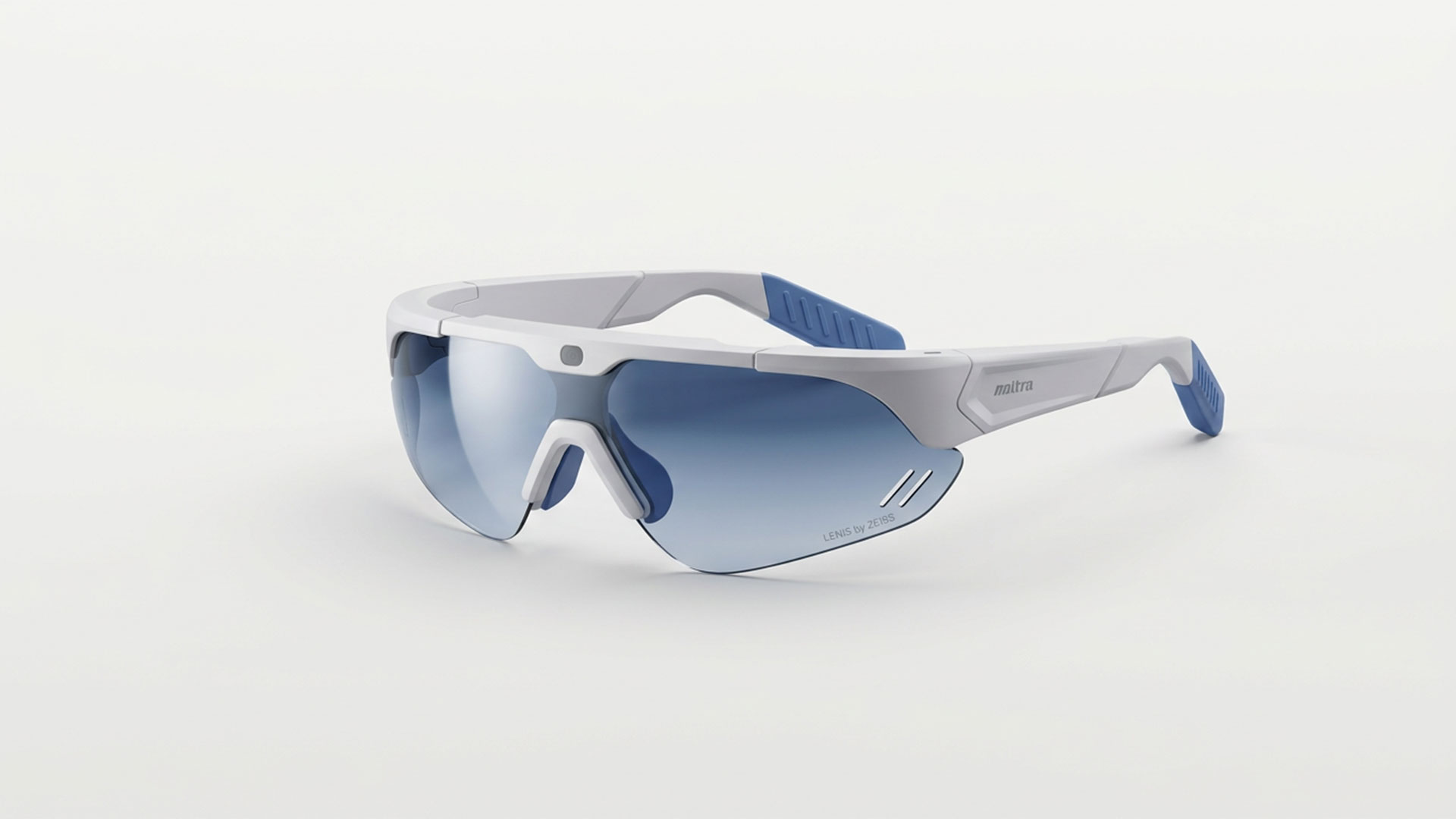
Wrap-around sports lenses. Large curved lenses reinforce the athletic character while providing the field of view and mounting area needed for visual sensing and future functional expansion.
Integrated temples. Beyond holding the glasses on the face, the temples are the primary real estate for electronics. PCBs, battery, speakers, microphone, antenna and controls are arranged inside a streamlined shape rather than bolted on.
Stable fit for movement. Flexible contact zones at the temple tips wrap the ears and keep the frame stable through running head motion.
Minimalist interaction. Removing dense buttons and displays positions voice and AI as the natural control method during exercise.
Interaction model: Sense → Understand → Respond. Because a wearer’s hands, gaze and attention are occupied during sport, the glasses — not a screen — become the gateway to the intelligent system:
  • Seeing: cameras and environmental sensors perceive the surroundings.
  • Sensing: the IMU and motion sensors understand the user’s movement state.
  • Understanding: local computing, a connected smartphone or cloud AI interpret the environment and intent.
  • Responding: open-ear audio and voice deliver feedback without demanding visual attention.
OPD DESIGN | ai sports glasses

Our AI Sports Glasses Development Process
Step 1-Product Definition & Market Research
We began with user scenario research for running and cycling, then translated the findings into product positioning, a feature list and an AI feature roadmap. A clear boundary was set for the first version: hands-free information, voice interaction and open-ear audio came first; lower-priority features were moved to later releases to protect weight, cost and battery targets.
 
Step 2-Industrial Design
With the solution direction set, the industrial design work moved from research to form. We studied how existing sports eyewear sits on the face and where users accept visible technology, then explored concept directions that kept electronics concealed. The chosen direction uses a sporty silhouette, a restrained color, material and finish palette, and detailing that reads as eyewear first and hardware second.
 
Step 3-Mechanical Design
Mechanical engineering had to resolve electronics and wearability at the same time. Key factors included frame dimensions, nose-pad design, contact points around the ears, temple length, overall center of gravity, left-right weight balance, stability during activity, fit across different head shapes, and comfort over long sessions.
The internal layout placed heavier components close to the head to prevent forward tilt and nose pressure. Every placement was a trade-off: moving the battery to balance the frame changed the space available for the speaker; routing the antenna away from metal improved wireless performance but reshaped the temple. These were resolved through collaborative layout iterations rather than by fixing the exterior first.
 
Step 4-Hardware & Electronic Design
For AI glasses, industrial design and electronic architecture are deeply interdependent, and this step was where the project’s core engineering work happened:
  • Camera placement changes the product’s appearance, field of view and internal structure.
  • Battery location changes total weight, center of gravity and wearing comfort.
  • Speaker placement sets acoustic performance and drives the shape of the temple arm.
  • Antenna position directly affects wireless communication reliability.
  • Processor choice dictates power consumption, thermal management and the physical dimensions available to the design team.
Because of these links, the hardware could not be developed by finalizing the shell and then “stuffing” components inside. AI capability drove processor, camera, sensor layout, PCB, battery, thermal and antenna decisions from the first architecture sketches, with structural and industrial design co-evolving alongside them.
 
Step 5-Firmware & Software Integration
The software work connected the sensing chain to the interaction model. Local processing handles the latency-sensitive tasks, while heavier interpretation can run on a paired smartphone or in the cloud. The control software also manages power and thermal behavior so that always-on sensing does not drain the battery or overheat the frame against the skin.
 
Step 6-Functional Prototyping

We built appearance and engineering prototypes to verify the full system: electronic and mechanical integration, camera and sensor placement, open-ear audio, voice interaction,

We built appearance and engineering prototypes to verify the complete system rather than the look alone. Verification covered electronic-mechanical integration, camera and sensor placement, open-ear audio quality, voice interaction, wireless connectivity, battery behavior and thermal performance under load.
Multiple prototype rounds were used: a rough proof-of-concept to confirm form factor and balance, an engineering prototype with real electronics to test the AI and audio chain, and a finished-look sample to confirm color, texture and assembly. Finding an interference or balance problem at this stage is far cheaper than finding it after tooling begins.
 
Step 7-Design Validation, DFM & Manufacturing Readiness
The final stage validated structural reliability, ergonomics, battery and power, thermal management, audio performance, wireless performance and AI functions, and confirmed the compliance pathway for the target markets — FCC authorization for the US, and CE marking (including the Radio Equipment Directive and RoHS) for the EU, with battery shipping and onboard-camera privacy considerations planned early.
The design was then reviewed for manufacturability and mapped to an NPI roadmap. Rather than walking every product through identical stages, OPD Design recommends the entry point based on technical certainty: projects with a proven approach can enter EVT directly, while a POC is reserved for unresolved direction or feasibility questions — which was the case for parts of this AI system.
 
OPD DESIGN | ai sports glasses

Project Results

The AI sports glasses development project delivered a validated concept and functional hardware platform, rather than stopping at renderings:
  • A production-feasible industrial design that houses camera, IMU, microphone, open-ear speakers, processor, battery and wireless module inside a lightweight sports frame.
  • A balanced mechanical layout tuned for weight distribution and stability during running and cycling.
  • An AI-ready hardware architecture that aligns camera, sensor, power, thermal, audio and antenna design in one co-developed system.
  • Functional prototypes that verified electronic-mechanical integration, open-ear audio, voice interaction and wireless connectivity.
  • A clear NPI roadmap from POC through EVT, DVT and PVT toward mass production, with US and EU compliance requirements identified.


OPD DESIGN | ai sports glasses

Developing AI glasses or another smart wearable? Send us your product idea — our team can take it from first concept to a production-ready design.

Featured Projects
1.What services did OPD Design provide for the AI sports glasses development?
OPD Design covered product strategy, industrial design, mechanical design, electronic engineering, software and AI integration, functional prototyping, and manufacturing-readiness planning. The project ran from concept definition to a functional prototype with a full NPI roadmap.

Concept-to-prototype timelines depend on feature scope, component sourcing and whether the technical approach is proven. For AI wearables, the POC and engineering validation stages typically take several months; we provide a milestone schedule during the initial consultation instead of quoting a fixed number upfront.

Not always. A POC is most valuable when product direction, core functionality or technical feasibility is still uncertain — which is common for AI glasses. If the technical approach is already well defined, a project can enter EVT directly. OPD Design recommends the entry stage after reviewing your requirements.
Wireless AI glasses generally require FCC authorization for the US and CE marking with the applicable directives (including the Radio Equipment Directive and RoHS) for the EU. Battery shipping rules and, where relevant, privacy requirements for onboard cameras also need early planning. We coordinate compliance preparation during DVT so issues surface before tooling.
Contact us through our website with your product idea and target use cases. We schedule an initial consultation, sign a mutual NDA before detailed discussions, then provide a proposal covering scope, milestones, timeline and investment. All design files and deliverables belong fully to the client.

Frequently Asked Questions

Ready to Start Your AI Sports Glasses Project?

From AI-driven concepts to functional hardware, OPD Design supports the full journey — product definition, technical feasibility, industrial and mechanical design, electronic engineering, prototyping and manufacturing introduction. Based in Shenzhen, we connect design directly with the component, PCB, mold and assembly supply chain, and assign English-speaking project managers with weekly updates for overseas clients.

Ready

Free Consultation

Inquiry Form