

Ai Sport Glasses
Client: A US-based tech startup
Services: Strategy|Industrial Design|Mechanical|Electronics|Software|Prototyping|Manufacturing
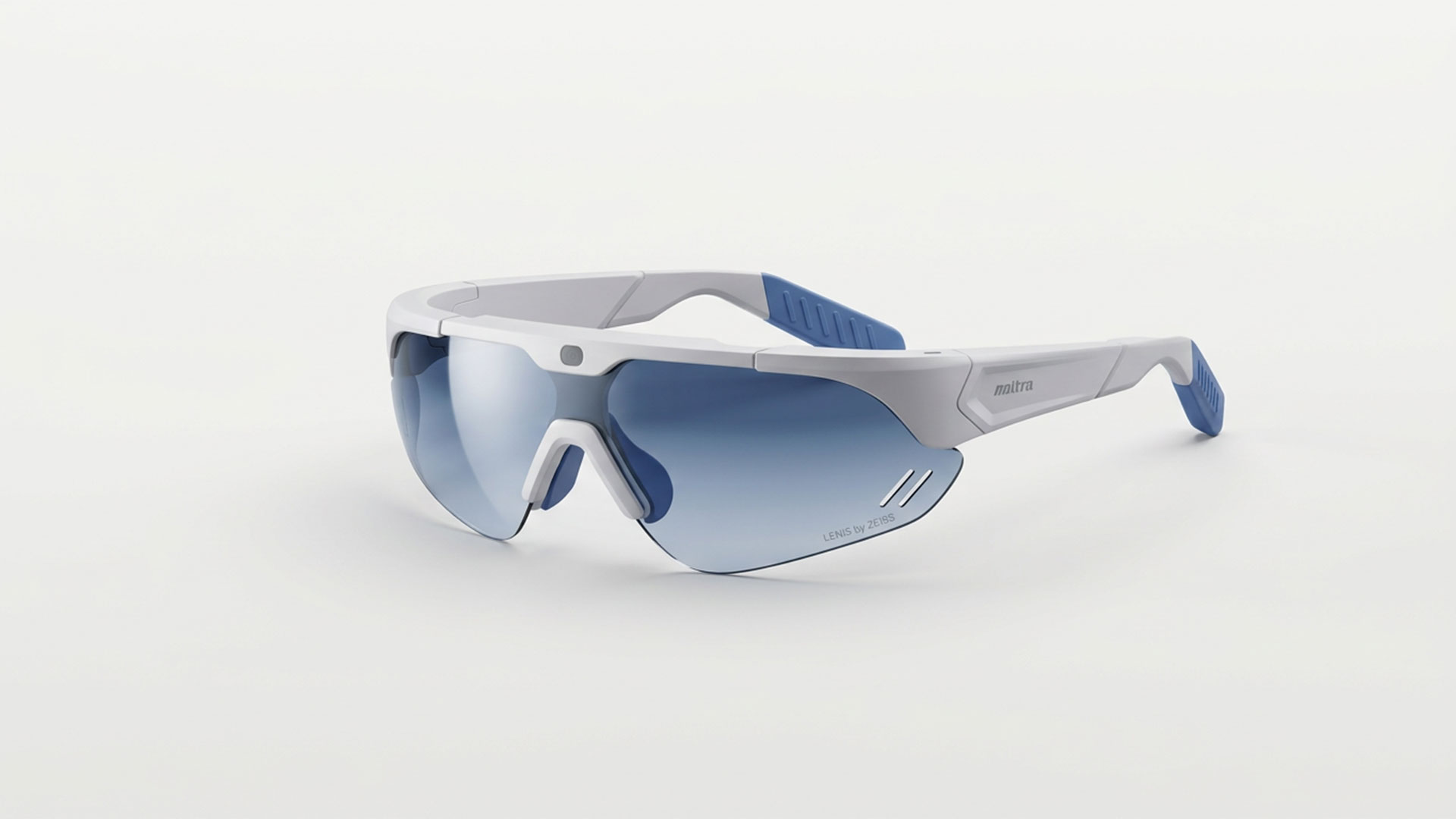
Integrating AI intelligence into the sports experience, this concept for next-generation athletic wearables embeds artificial intelligence, environmental sensing, motion tracking, open-ear audio, and wireless connectivity into a pair of lightweight sports glasses.
The project encompassed the entire product development lifecycle—from initial definition, industrial design, and ergonomics to AI hardware architecture, structural and electronic system integration, prototype validation, and preparation for mass production.
Project Background
Smart glasses are evolving from traditional vision-aid devices into a new generation of intelligent terminals that integrate AI, sensors, audio, computing, and wireless connectivity. For activities such as running, cycling, and other outdoor sports, users require real-time access to information—yet they prefer to avoid the inconvenience of frequently reaching for their smartphones or navigating complex controls.
With this in mind, OPD has explored an “AI Sports Glasses” concept tailored for the future athlete. Built upon the foundation of athletic eyewear, the design incorporates a camera, an inertial measurement unit (IMU), a microphone, open-ear speakers, a processor, a battery, and a wireless communication module—all seamlessly integrated into the frame and temples.
The core of this design is not merely “adding AI to a pair of glasses”; rather, it involves approaching the product as a holistic system—integrating AI capabilities, hardware architecture, industrial design, ergonomics, structural engineering, and user interaction from the very outset.
Solution
Traditional smart devices rely on screens for information access and interaction. However, during physical activity, a user’s hands, gaze, and attention are often not available for operating a smartphone. Consequently, AI glasses can serve as a more natural gateway connecting users to intelligent systems.
Seeing: Perceiving the surrounding environment via cameras and environmental sensors.
Sensing: Understanding the user’s movement state through sensors such as an IMU (Inertial Measurement Unit).
Understanding: Analyzing the environment and user needs through local computing, a connected smartphone, or cloud-based AI.
Responding: Providing feedback to the user via voice, open-ear audio, or other modalities.
Sense → Understand → Respond: Bringing AI out from behind the smartphone screen and into real-world physical activity scenarios.

Lightweight design for comfortable wear
Since sports eyewear is intended for long-term wear, the product design must prioritize overall weight, center-of-gravity distribution, pressure on the bridge of the nose, points of contact around the ears, stability during physical activity, and comfort over extended periods. The frame and temples are designed to achieve a sporty aesthetic while providing well-integrated space for potential electronic components.
Integrating AI Capabilities into Hardware
AI is not merely a standalone software feature; it fundamentally influences the selection of processors, camera placement, sensor layout, PCB design, battery integration, thermal management, antenna positioning, audio systems, and overall structural design. Consequently, AI capabilities must be factored into hardware architecture planning from the very inception of the product concept.
Natural Interaction During Exercise
Users should not have to frequently manipulate their device while engaged in physical activity. Therefore, this product concept centers on voice control, open-ear audio, and environmental awareness—enabling users to access information, communicate, or receive assistance from an AI, all while remaining fully immersed in their workout.

How can complex AI technology be concealed within a pair of glasses?
AI-powered wearable devices present a unique design paradox: while the product must accommodate an ever-increasing amount of technology, users expect it to appear increasingly simple.
A pair of AI glasses might need to house a camera, IMU, microphone, speaker, PCB, processor, battery, antenna, and power management system—yet, to the end user, the device should still look and feel like a lightweight, comfortable, natural, and reliable pair of sports glasses.
Consequently, product development requires a careful balancing act, ensuring coherence across electronic integration, structural design, ergonomics, thermal management, acoustic engineering, wireless performance, and industrial design.
Tech products can also have a natural appearance.
This product adopts the design language of modern sports eyewear. Through the use of wrap-around lenses, streamlined temples, and a clean structural layout, it strikes a balance between a sporty aesthetic, a high-tech feel, and suitability for everyday wear. Rather than deliberately exposing electronic components, the design allows technology to integrate naturally into the product’s form.
Wrap-around Sports Lenses
The large, curved lenses reinforce the product’s athletic character while providing a foundation for visual sensing systems and future functional expansions.
Integrated Temples
Beyond their primary function of securing the eyewear, the temples serve as a vital space for housing electronic systems. Depending on the final hardware architecture, components such as PCBs, batteries, speakers, microphones, antennas, and control buttons can be seamlessly integrated.
Stable Fit for Physical Activity
The ends of the temples feature flexible contact zones, ensuring a secure fit around the ears and keeping the eyewear stable during movement.
Minimalist Interaction
By stripping away the complex buttons and display elements typical of conventional electronic devices, the design positions voice and AI as more intuitive, natural gateways for interaction.

Considering Electronic Systems from the Perspective of Product Form
For AI glasses, there is a deep interdependence between industrial design and electronic architecture. The placement of the camera affects the product’s appearance, field of view, and internal structure; the battery’s location influences the device’s weight, center of gravity, and wearing comfort; the positioning of speakers impacts acoustic performance and the design of the temple arms; the placement of antennas affects wireless communication performance; and the processor dictates power consumption, thermal management, and the overall physical dimensions of the product.
Consequently, the development of AI hardware cannot follow a process where the exterior is finalized before the electronic components are “stuffed” inside. Instead, it requires collaborative design, beginning at the earliest stages of product architecture.
Potential System Architecture for AI Glasses
Perception Layer: Camera, IMU, Microphone, Environmental Sensors
Computing Layer: MCU / SoC / AI Computing Platform
AI Capabilities Layer: Computer Vision, Voice AI, Context Awareness
Interaction Layer: Open-Ear Audio, Voice Interaction, Physical Controls
Connectivity Layer: Bluetooth, Wi-Fi, Smartphone, Cloud
Architectural Note: The final hardware architecture for any given product must be defined based on target functionality, AI computing power, power consumption, cost, form factor, and usage scenarios. The product development process at OPD begins with product definition and technical feasibility analysis; the core technical roadmap is established during the Proof of Concept (POC) phase, followed by a transition into full-scale engineering development.
Synergy Between Electronic Systems and Ergonomics
The structural design of AI glasses must address not only the placement of electronic components but also how the device is worn by the user. Key considerations include frame dimensions, nose pad design, points of contact with the ears, temple length, the product’s center of gravity, weight balance between the left and right sides, stability during physical activity, adaptability to various head shapes, and comfort during extended wear. Ultimately, the structural design requires striking a balance among electronic component integration, structural reliability, ergonomics, and industrial design.

End-to-End Product Development
From Product Concept to Real-World Product
AI glasses are not merely an industrial design project; they require collaboration across multiple professional disciplines.
User Scenario Research
Product Positioning
Feature Definition
AI Feature Planning
Product Roadmap Planning
Industrial Design
Product Form/Styling
Ergonomics
CMF (Color, Material, Finish)
Product Details
Brand Design Language
Internal Architecture
Electronic Component Integration
Structural Design
Reliability
DFM
Hardware Architecture
Chip and Component Selection
PCB
Power Management
Sensors
Audio Systems
Wireless Communication
Mold Development
DFM (Design for Manufacturing)
Small-Batch Trial Production
Mass Production Introduction
NPI Product Development Process
From Proof of Concept to Mass Production
OPD employs an NPI (New Product Introduction) development process—comprising POC, EVT, DVT, PVT, and MP—to systematically validate product concepts, engineering designs, complete designs, and manufacturing processes as the product matures.
Product Concept Validation
Market and User Research
Product Positioning and Use Case Definition
AI Feature Definition
Core Technology Analysis
Evaluation of Chips and Key Components
Preliminary Hardware Architecture
Product Development Roadmap
Engineering Verification
Industrial Design Refinement
Structural Design
Hardware Development & PCB
Firmware
AI / Software Integration
Electronic and Mechanical System Integration
Engineering Prototypes
Core Functionality Verification
Design Verification
Structural Reliability
Ergonomics
Battery and Power
Thermal Management
Audio Performance
Wireless Performance
AI Capabilities
Reliability Testing
Design Optimization and Compliance Preparation
Production Validation
Mold Development
DFM (Design for Manufacturing)
Process Development
Assembly Verification
Production Fixtures
Quality Standards
Small-Batch Trial Production
Production Testing
Entering mass production
Supply Chain Coordination
Mass Production Ramp-up
Quality Control
Production Monitoring
Final Assembly
Packaging
Mass Production Support
Why OPD
Why does AI hardware require the integration of design and engineering?
Every product decision regarding AI hardware has the potential to impact other systems. For instance, AI features dictate computational requirements, which in turn influence hardware architecture—subsequently affecting power consumption, battery life, thermal management, mechanical structure, industrial design, and the overall user experience (such as wearability).
If these tasks are handled in complete isolation by different suppliers, the product development process is prone to interface issues and the need for repetitive revisions. The OPD product development model integrates product strategy, industrial design, structural engineering, electronic engineering, software, AI, prototyping, and manufacturing into a unified development ecosystem.
Connecting the real-world supply chain—from design to manufacturing
Based in Shenzhen, OPD provides access to a comprehensive supply chain—encompassing electronic components, PCBs, structural parts, molds, prototyping, and full-scale assembly. This enables product development teams to address critical factors early on, such as component availability, structural manufacturing processes, moldability, assembly methods, Design for Manufacturing (DFM), costs, supply chain logistics, and mass-production feasibility.
For AI-powered wearable products, design is not the end goal; rather, it serves as the starting point for the entire manufacturing process.
Project Highlights
AI Hardware: Product concepts for the next generation of intelligent hardware
Wearable Technology: Ergonomics and user experience centered on activity-based scenarios
AI Integration: Hardware convergence incorporating vision, voice, sensing, and AI capabilities
Integrated Product Architecture: Co-design spanning industrial design, mechanical structure, and electronic systems
NPI-Ready Thinking: A productization roadmap—from POC through EVT, DVT, and PVT to MP (Mass Production)
End-to-End Development: A comprehensive development approach—from product concept to prototyping, engineering, and manufacturing
Future of AI Wearables
The next generation of AI is gaining a physical form.
AI is transitioning from computers and smartphones into the real world. Future AI will go beyond simply answering questions; it will be able to perceive its environment, interpret scenes, recognize users, grasp context, and provide assistance at the right moment.
This means that competition among AI products is no longer defined solely by algorithmic prowess. It now encompasses hardware design, user interaction, wearability, system architecture, and the ability to translate complex technology into truly usable products. AI-powered eyewear is merely the starting point for this next generation of intelligent hardware.
Have an
AI Hardware Idea?
From AI-driven concepts to tangible products—whether you are exploring AI glasses, smart wearables, edge AI devices, or the next generation of smart hardware—OPD supports you every step of the way. We guide the process from product definition and technical feasibility assessment through design, engineering, and prototyping, all the way to mass production.
Let’s Turn Your AI Hardware Idea Into a Real Product.
FAQ
1. What features can be integrated into AI-powered sports eyewear?
Depending on their intended product positioning, AI sports glasses can integrate components such as cameras, IMUs, microphones, open-ear speakers, wireless communication modules, and AI processing capabilities. The final hardware configuration must be defined based on functional requirements, power consumption, physical dimensions, cost, and specific use cases.
2. Can OPD develop AI smart glasses?
OPD can provide services for AI smart glasses, covering product strategy, industrial design, structural design, electronic engineering, software development, prototype validation, and manufacturing introduction. The specific scope of development is determined based on project requirements.
3. What factors need to be considered in the industrial design of AI glasses?
Beyond the product’s external appearance, it is also necessary to simultaneously consider factors such as weight, center of gravity, wearing comfort, camera placement, audio system, battery, PCB, antennas, thermal management, and structural space.
4. Should AI hardware projects begin with a POC?
Not necessarily. For projects with a clearly defined technical approach, one can proceed directly to the EVT (Engineering Validation Test) phase or other appropriate stages of development. A POC (Proof of Concept) is primarily intended for projects where there remains significant uncertainty regarding the product direction, core functionality, or technical feasibility.
5. Can OPD handle everything from design to mass production?
OPD’s services encompass product strategy, industrial design, mechanical design, electronic engineering, software, prototyping, tooling, manufacturing, and the NPI (New Product Introduction) development process. The specific scope is determined based on project requirements.
Featured Projects

Wearable Brain-Computer
All-Age EEG Intervention Device, Forehead-Worn, Safe and Adjustable.
Smart Ring
A health-tracking wearable ring equipped with heart rate, sleep, and body temperature monitoring features.

AI interactive terminal
This project uses AI to recognize NFC chips, match IP-specific audio effects, enabling “one Baji, one exclusive interaction”

Translation Headphones
A pair of wireless Bluetooth translation earbuds that provide real-time voice translation services for travelers and international users.